
VOL. 07 | ISSUE 2 | June 2024
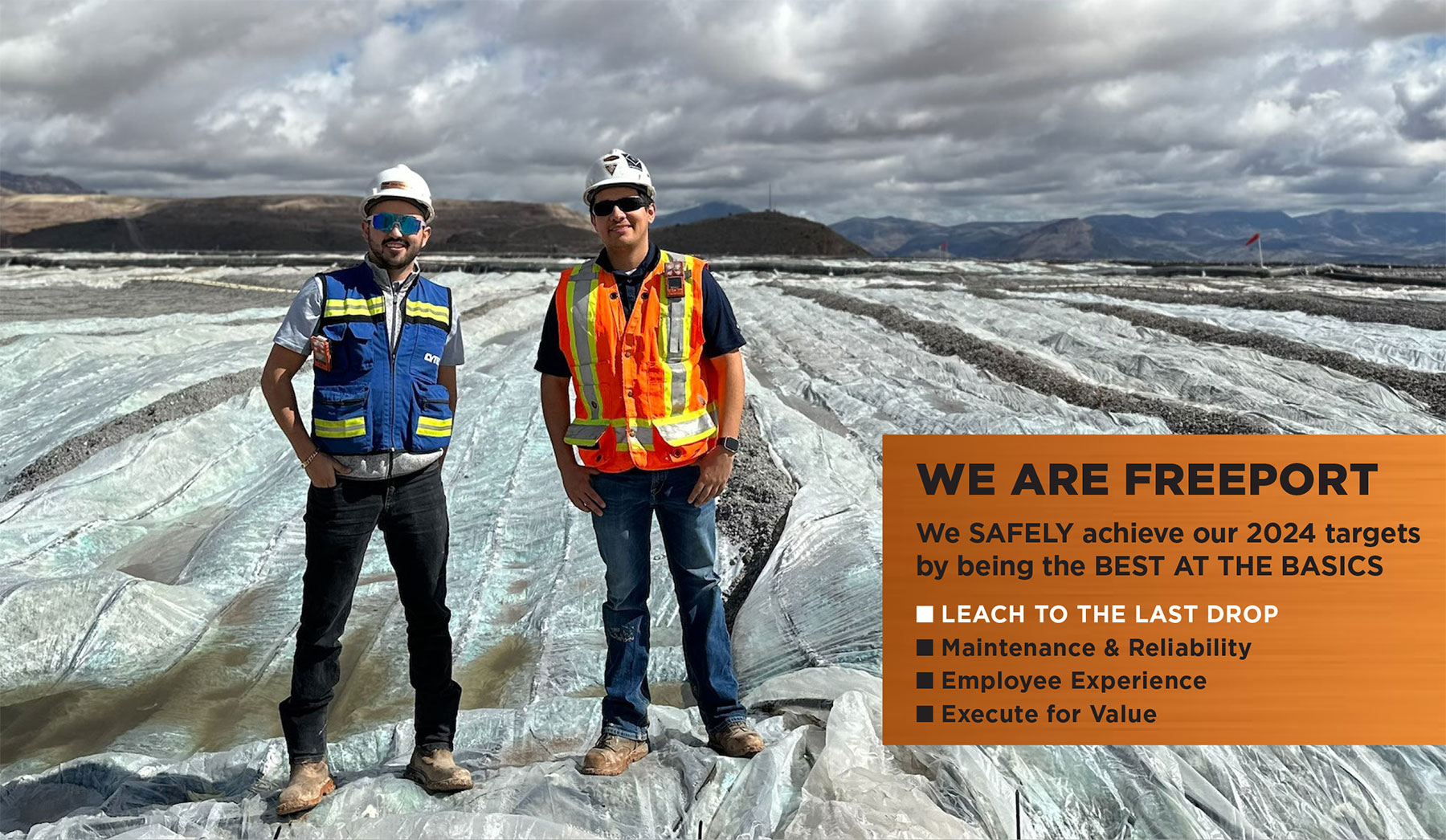
Morenci Employees Othon Palma Duque, left, and Javier Fernandez Duran struggled to get the Mantos covers they needed in Morenci before an innovative agreement was crafted to finance a new factory in Mexico.
Innovative Deal Ensures Steady Supply of Covers For Leach to the Last Drop
Plastic sheeting with built-in drip lines was exactly what was needed to cover stockpiles in Morenci and squeeze out more copper as part of the company’s Leach to the Last Drop initiative.
But there were challenges.
The only company making the patented product – Mantos – is a small manufacturer in Chile that already was working near capacity to meet the needs of its existing customers. Freeport was looking to buy millions of square feet of the material annually.
It also didn’t help that the factory was on the other side of the hemisphere, adding to the cost and delays associated with shipping large quantities of the material through a sluggish global transportation network.
What was needed was an innovative approach. Fortunately, that’s what Leach to the Last Drop is all about.
Shortly after the supply quandary was identified in Morenci, the company’s Global Supply Chain and Corporate Development departments were brought in to figure out a way to help Mantos increase the output of material and decrease the distance it had to be shipped.
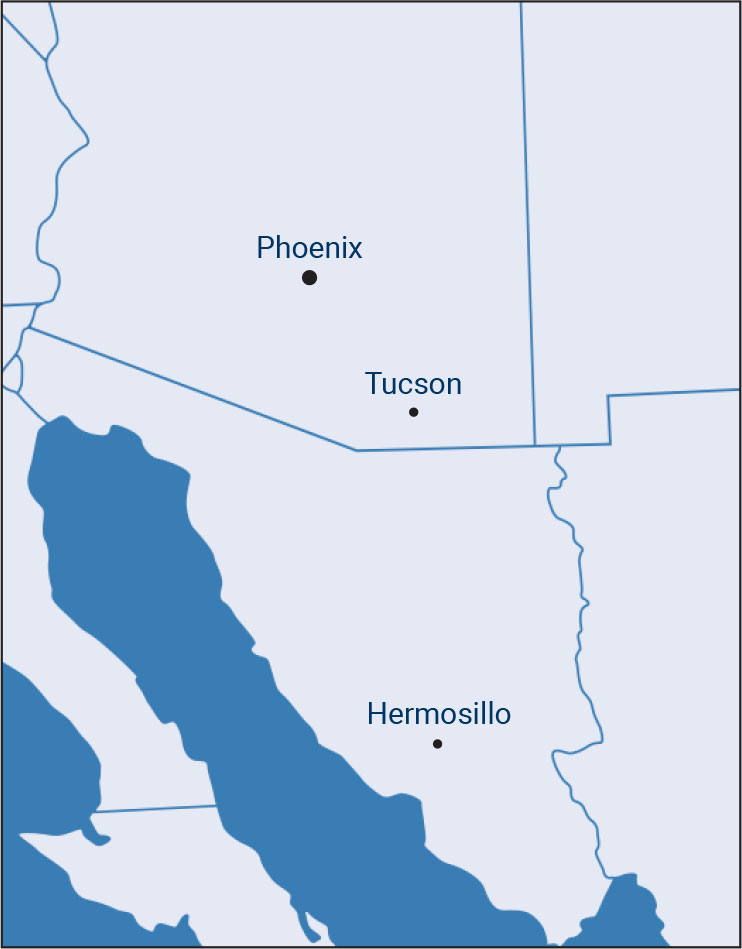
They soon had a solution. Freeport provided the up-front financial support to build a new Mantos factory in Hermosillo, Mexico, just across the border from the company’s mines in Arizona and New Mexico. The approximately $2 million will be repaid with interest through discounts on the price of the material it purchases.
The company approved the deal in August 2023, and the plant began cranking out material for Freeport’s stockpiles earlier this year.
The Mantos project’s success illustrates the collaboration and creative thinking that is driving Leach to the Last Drop, which extends from the front lines at the sites to the corporate office, said Dan Kravets, Vice President-Corporate Development and Exploration.
“The Corporate Development team often is asked to engage when the company is faced with complex opportunities, which may involve finance, commercial, legal or technical matters,” Kravets said. “We help facilitate collaboration as one Freeport team to identify innovative solutions to develop our assets for profitable, long-term growth and are guided by a mandate to drive execution reliably and responsibly.”
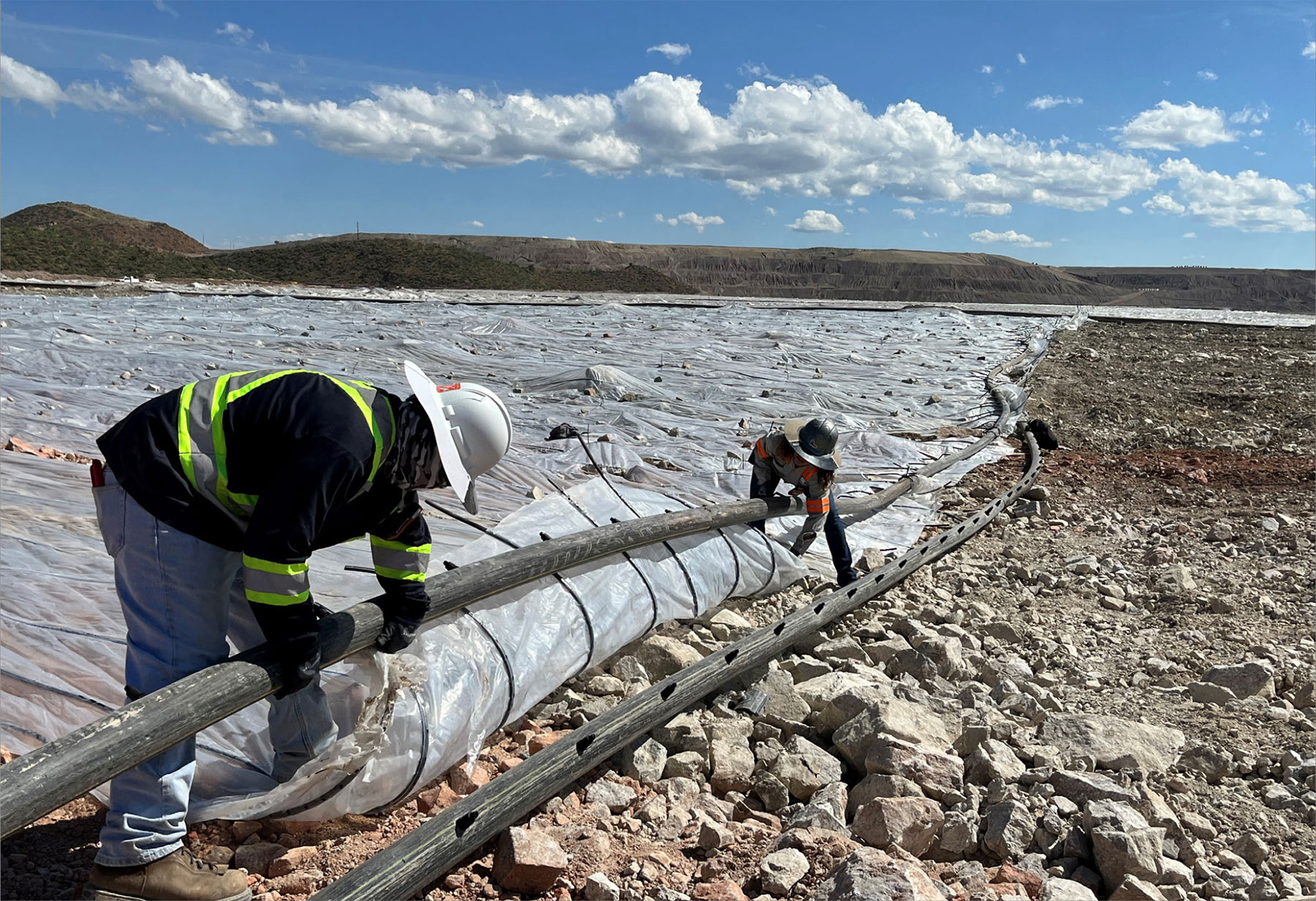
Workers install Mantos covers in Morenci, where about half of the new copper from Leach to the Last Drop is produced.
Call for help
Morenci is the epicenter of Leach to the Last Drop’s success, accounting for about half of the copper recovered through the initiative. A key component of the leaching plan is to cover stockpiles with plastic sheeting, thereby creating a greenhouse effect, which raises temperatures, fosters chemical reactions and ultimately leads to more copper recovery.
Hydromet crews tested different brands of material, and Mantos proved the best, said Javier Fernandez Duran, Metallurgist I-Morenci. Other products required drip lines to be installed separately before the stockpiles were covered. The Mantos product has integrated drip lines fused at regular intervals onto the plastic, so it can all be done in one step. It is also heavier and therefore less prone to blow around during and after installation.
When you talk about Leach to the Last Drop you are talking about innovation. With so much money at stake it is essential to be flexible around these kinds of opportunities to really seize the value that’s out there. If we weren’t we would be leaving a lot of money on the table, or more literally a lot of copper on the stockpiles.
Getting the Mantos covers was problematic, said Othon Palma Duque, Business Intelligence Analyst I-Morenci. With a single undersized factory in Chile, it typically took three to six months to get the product delivered when it was available. And Morenci needed a lot of it. In 2023 alone, it covered 37 million square feet of stockpiles, about 90 percent with Mantos’ product.
By early 2023, there were discussions about building a factory closer to Freeport sites in the United States. However, Mantos could not get the financing to essentially serve a single customer – Freeport – without long-term guarantees.
At that point, the people in Morenci put out a call for help to the corporate office, Palma Duque said.
“We were losing the potential to recover more copper and therefore losing money by being limited in having Mantos in our hands,” he said. “It was hard for us, for a project that’s worth 30 million pounds a year, to be dependent on a company that’s 15 countries away.”
‘Take or pay’
The call for help went to Global Supply Chain group where the cause was taken up by Robert Champlin and Daniel Christensen, both Strategic Category Managers.
Mantos negotiators wanted Freeport to guarantee it would purchase a certain quantity of the covers annually, even after the financing was repaid and regardless of whether it is needed, Champlin said. That sort of “take or pay” arrangement is not unusual when a small company is seeking financing to build a factory to supply a single large customer. However, it is not a good strategy for the buyer.
Champlin and Christensen tried for months to work out a solution that would allow Mantos to secure financing without committing Freeport to a long-term obligation. Given the importance of the covers, it would have made financial sense just to give Mantos the money, but there was no mechanism to make that kind of unique financial arrangement, Champlin said.
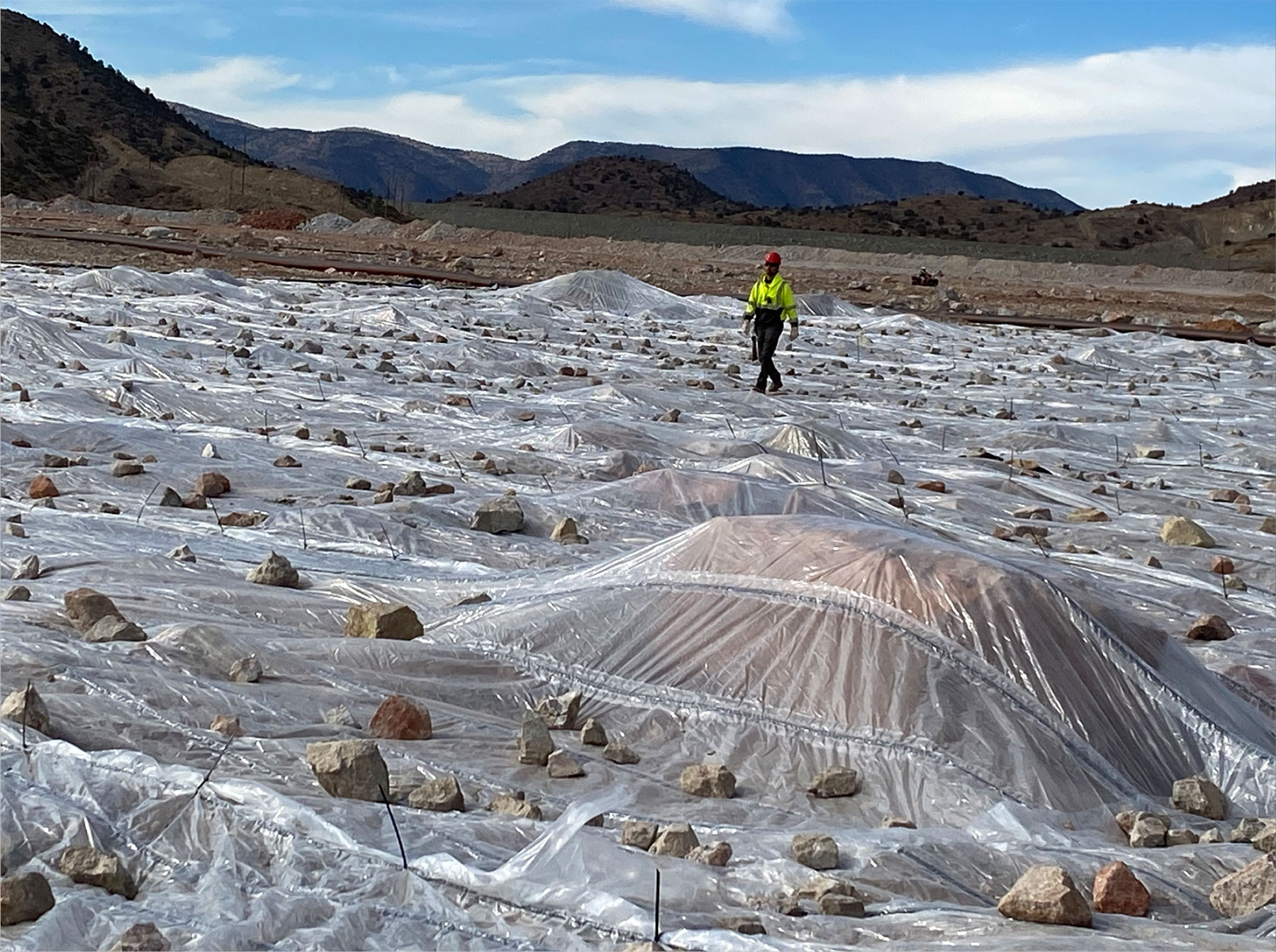
Covering leach piles is meant to create a greenhouse effect, increasing heat and resulting in greater copper production.
Innovative problem solving
Word of the impasse reached Kravets about June 2023. Kravets organized a series of discussions with those already involved. He also brought in David LeBlanc, Senior Manager-Corporate Development, and representatives of Freeport’s office in Santiago, Chile, who all worked closely with Morenci to drive execution.
The innovative solution they came up with was to have Freeport front the money to build the factory and have it repaid through discounts in future purchases of the product, Kravets said. That allowed Mantos to finance its factory without obligating Freeport to future purchases that it may not need.
The proposal made so much economic sense that it was formally submitted to the company on July 25 and approved on August 1.
Mantos chose the location in Mexico, and the factory began producing material in February.
It will take about two-and-a-half years for Freeport to recoup its investment plus a reasonable return.
“When you talk about Leach to the Last Drop, you are talking about innovation,” Palma Duque said. “With so much money at stake, it is essential to be flexible around these kinds of opportunities to really seize the value that’s out there. If we weren’t, we would be leaving a lot of money on the table, or more literally a lot of copper on the stockpiles.”