
VOL. 08 | ISSUE 2 | Summer 2025
The Right Balance
Getting the Right Balance Protects Leaching
Stockpiles and Maximizes Copper Production
Any kid building a sandcastle quickly learns the secret is getting the right mix.
Too dry, and you can’t build anything.
Too wet, and you get a slushy mess.
The same holds true for leaching copper out of old stockpiles through Freeport’s Leach to the Last Drop initiative. Acidic solution – raffinate – is being put into the stockpiles either through percolation from the surface or forced injection.
If enough raffinate is not pumped, it will not saturate the ground sufficiently to unlock the untapped copper. If too much goes in, it can compromise the integrity of the stockpile, leading to blowouts on the sides or potentially slope collapse.
The company deploys an array of sophisticated sensors, monitors, and even prism and satellite technology to make sure that never happens. Finding the right balance can be tricky in stockpiles that might have been built decades ago and which constantly change in composition, shape and geology during the leaching process.
“A lot of Leach to the Last Drop has to do with getting dry rocks wet,” said Frank Van de Wille, General Manager-Site Sustaining Capital. “When you do that, you are changing the dynamics of the stockpile, and you’ve got to take the appropriate precautions to protect those assets. The last thing that we want to do is to have one of our stockpiles fail catastrophically. That would negate the gains we’ve gotten from anything we’ve done related to Leach to the Last Drop.
“It’s all about doing the right things to protect the assets. That’s one of the hallmarks of Leach to the Last Drop.”
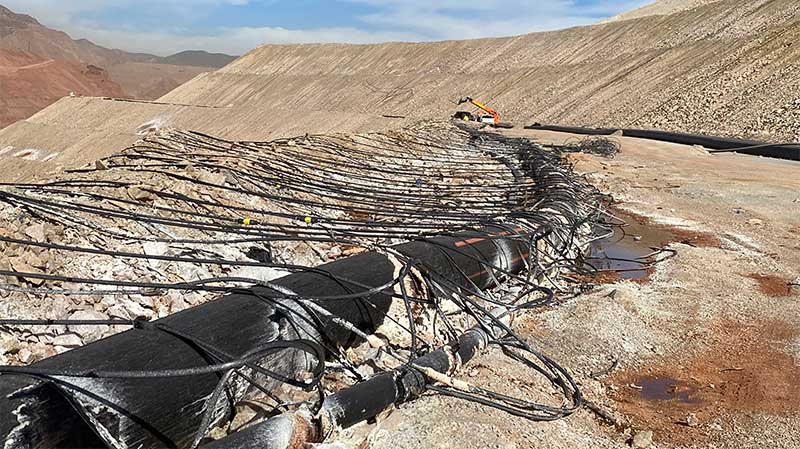
Stockpiles require extensive monitoring during leaching so the right amount of solution is being used in the right places.
“It’s all about doing the right things to protect the assets. That’s one of the hallmarks of Leach to the Last Drop.”
FRANK VAN DE WILLE | GENERAL MANAGER | SITE SUSTAINING CAPITAL
Every stockpile is different. Run of mine, or ROM, uses uncrushed material straight from the shovel and is a mix of big and small rocks with smaller particles of dirt and dust. If that gets overly saturated, it is more likely to erode or channel than collapse, said Justin Cross, Vice President-Operational Improvement. Crushed leach stockpiles, where the material is crushed to a uniform size, can be more complicated because it is more apt to flow if it gets too wet – like slushy sand.
The amount of raffinate going into the stockpiles is closely monitored and should be roughly the same as the volume drawn out from the bottom. If not, that might indicate raffinate is pooling somewhere inside, which can create instability.
An array of sensors and extensive lab analysis of material drilled out of the piles help determine whether raffinate is disbursing as it should or cutting through previously established flow channels, which limits coverage of copper-bearing material. If raffinate is not flowing correctly, it can be adjusted, moved or rechanneled to help ensure proper saturation of more ground. If it is found to be pooling, the usual practice is to stop applying raffinate to avoid weakening the stockpile. If the amount of liquid is found to be creating instability, it also can also be drained, pumped or wicked away through bore holes.
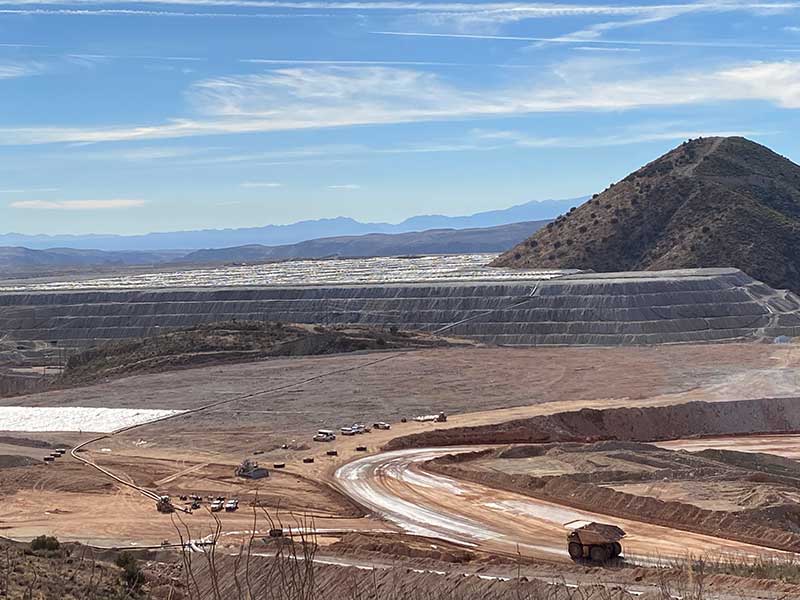
Adding acidic liquid, drilling holes and covering stockpiles changes the composition of stockpiles and requires extensive monitoring to help ensure their stability.
“Because we are changing solution paths, because we are putting solution in depth, we want to be very thoughtful around how this is changing the risk profile of these stockpiles,” Cross said. “We are using more sensoring technology to understand not only the characteristics of the stockpile but how we change them with these different tactics.”
Cross added that protecting the stability of the stockpile is “among the highest priority risks to manage” along with things like worker safety and environmental protection.
“It’s among the most important things to stay ahead of and engineer around,” he said. “We are anticipating things that could creep up on us and getting ahead of them.”
“Because we are changing solution paths, because we are putting solution in depth, we want to be very thoughtful around how this is changing the risk profile of these stockpiles.”
JUSTIN CROSS | VICE PRESIDENT | OPERATIONAL IMPROVEMENT
Sensors and Satellites Can’t
Replace Boots on the Ground
A lot of sophisticated gadgetry goes into leaching stockpiles to help ensure their stability when acidic raffinate is used.
There are piezometers and flow meters to keep track of the solution. Global positioning systems, prisms and slope stability radars monitor the shape and structure. Even satellites make sure the ground is not shifting.
And that doesn’t count things like oxygen and heat sensors embedded to maximize copper recovery.
But none of that technology is as important as the workers who walk the stockpiles regularly looking for signs of trouble.
“We cannot just rely on the technology,” said Teno Siburian, Principal Engineer II-Tucson and former Morenci Chief GMX Engineer, who is part of the team that monitors the stability of leaching stockpiles. “A plan on paper is always good, but in the field you need to verify if it is working as planned. Our best monitoring system is our eyes because technology is just technology.
“You still need to go into the field and see all the changes, see all the puddles, see all the small cracks and broken pipes. We can only see that with our eyes.”
Sensors and Satellites Can’t
Replace Boots on the Ground
A lot of sophisticated gadgetry goes into leaching stockpiles to help ensure their stability when acidic raffinate is used.
There are piezometers and flow meters to keep track of the solution. Global positioning systems, prisms and slope stability radars monitor the shape and structure. Even satellites make sure the ground is not shifting.
And that doesn’t count things like oxygen and heat sensors embedded to maximize copper recovery.
But none of that technology is as important as the workers who walk the stockpiles regularly looking for signs of trouble.
“We cannot just rely on the technology,” said Teno Siburian, Principal Engineer II-Tucson and former Morenci Chief GMX Engineer, who is part of the team that monitors the stability of leaching stockpiles. “A plan on paper is always good, but in the field you need to verify if it is working as planned. Our best monitoring system is our eyes because technology is just technology.
“You still need to go into the field and see all the changes, see all the puddles, see all the small cracks and broken pipes. We can only see that with our eyes.”
“We cannot just rely on the technology. A plan on paper is always good, but in the field you need to verify if it is working as planned. Our best monitoring system is our eyes because technology is just technology.”
TENO SIBURIAN | PRINCIPAL ENGINEER II | TUCSON
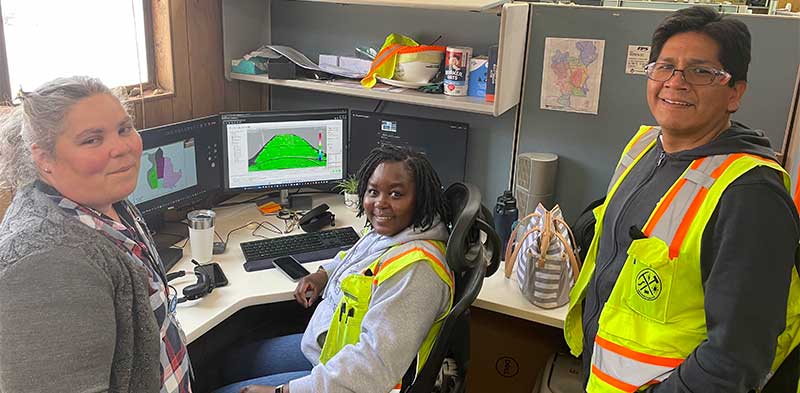
Michelle Montague (left), Chief Engineering Specialist; Judith Buaba, Mine Engineer II; and Juan Marca Flores. Senior Geomechanical Engineer, are part of the team that monitors the condition of the Morenci leach stockpiles.
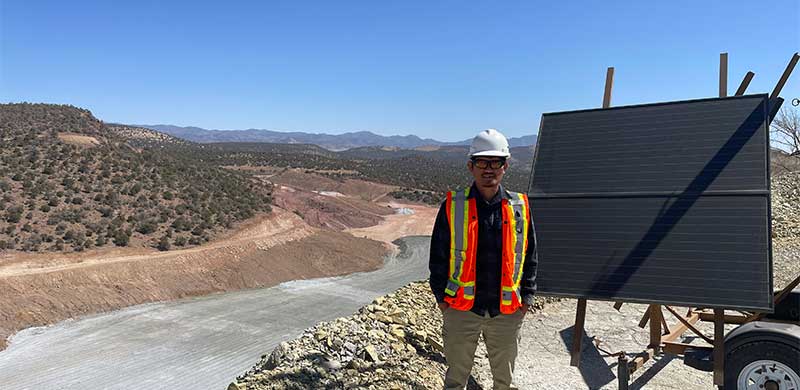
Teno Siburian, Principal Engineer II-Tucson, said nothing replaces a watchful eye in monitoring the stability of stockpiles under leach.
Leach to the Last Drop is Freeport’s innovative approach to using new leaching methods to extract copper from existing stockpiles. Estimates are there are about 40 billion pounds of copper in old stockpiles that can be recovered using the new techniques, which include getting raffinate to new areas such as side slopes and dry pockets missed with traditional methods. To do that, raffinate is applied on the surface or through injection.
Putting liquids into the stockpiles can weaken them over time, especially since many are decades old and were not designed with that sort of saturation in mind.
Making sure the stockpile does not get overly saturated is what much of the monitoring is about, Siburian said. Piezometers are embedded at various depths to track the fluid elevation and pressure inside the stockpile.
Flow meters are used to monitor how much liquid is going in at the top and coming out the bottom as copper-infused pregnant leach solution. The amount of raffinate going in and coming out should be roughly the same. If not, it would indicate accumulation inside the stockpile which could lead to blowouts or even a collapse of the structure.
Bore holes are drilled to determine the composition of material throughout the stockpile to the base. Since leaching can change the composition of the material, samples generally are taken annually. Once a hole is drilled, it typically is used to place more monitoring equipment.
Ground-penetrating technology also is used to identify dry areas the raffinate is not reaching and where channeling or pooling might be occurring below the surface.
In addition to what’s in the ground, technology like GPS, radar, prisms, drones, slope stability radars and satellites are used to check for changes or deformations in the shape of the stockpile, which could be an early warning sign of a possible slope failure.
“Everything is important but monitoring the level of the liquid is really critical because when you have the increased pressure, it could create a blowout or a failure,” Siburian said. “We have the technology to know where it is flowing, where it’s wet or not, knowing if there is any water ponding. We are using all of these technologies to understand the displacement of the slope so that we can make the right decisions.”