
VOL. 08 | ISSUE 2 | Summer 2025
Doc Talk:
On the Road to Proper
Health and Wellness
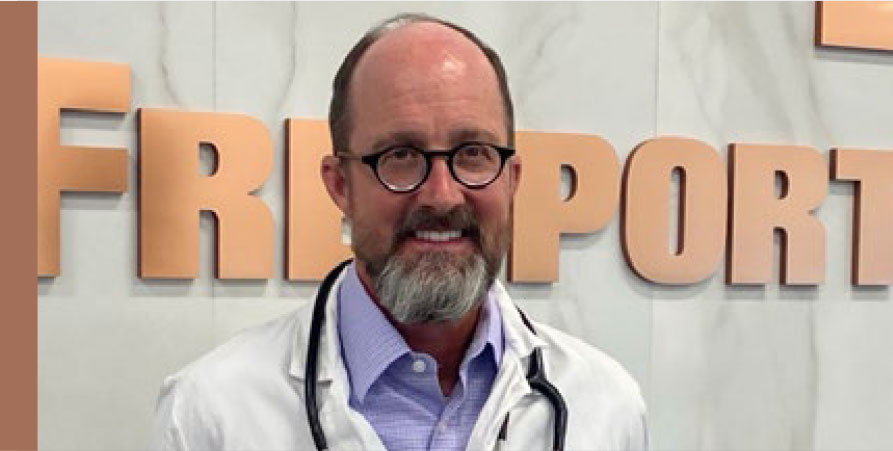
This article is part of a regular feature for The Miner called Doc Talk, in which Dr. Richard Vinroot, Vice President and Global Medical Director, addresses topics related to the health and wellness of Freeport employees.
Running a Fortune 200 company with operations around the globe means employees frequently find themselves traveling for work.
In 2024 alone, nearly 3,000 Freeport employees in North America ventured somewhere away from their normal workplace to conduct business. In some cases, travel may have been a relatively simple road trip to a neighboring site. In others, that may have been 17,500-mile round trip to the company’s PT Freeport Indonesia operation.
Whether it’s traveling abroad to areas with different laws and social customs, to different climates and altitudes or when already managing other health conditions, maintaining proper health and wellness when traveling for business is critical.
In this Doc Talk, Dr. Richard Vinroot, Vice President and Global Medical Director, discusses the importance of planning ahead when traveling on behalf of the company to help ensure a positive experience and a return in good health.
Freeport employees regularly visit some of the most diverse climates and social cultures in the world. How can they best prepare?
Know your environment, know where you’re going, and think about things that might be issues for you, especially if you have medical problems. People need to remember that medical problems can be exacerbated somewhere else due to altitude or heat – these can be problematic.
Not only that, but some medications people take in the U.S. can’t be taken elsewhere because they can be illegal. People need to think about that. Medical marijuana is not legal in many other countries. We don’t allow it on our sites anyway, but if they are taking it in another country, they could go to jail.
In fact, some medications like those used to treat ADHD and anxiety and narcotics for pain could be illegal, and someone could risk being put in jail having those drugs. Controlled substances are a big problem, and people think because their doctor has prescribed it, they are OK in another country. That may not be the case.
Packing Smart
A proper travel health kit may consist of the following items:
Documents
- Copies of your passport and travel documents
- Contact card with the street addresses, phone numbers and email addresses of a family member or close contact in the United States
- Lodging information for your destination(s)
- Information for your healthcare professional(s) at home
- Copy of immunization records
- Proof of yellow fever vaccination (if required for your trip)
- Copies of prescriptions (medications, glasses or medical supplies)
- Health insurance card and documents (including travel insurance)
- List of hospitals or clinics (including emergency services) in your destination(s)
- U.S. embassy or consulate information for your destination(s)
Supplies
- Diabetes testing supplies
- Disease-specific rapid tests
- Earplugs
- First-aid kit
- Glasses, contact lenses, contact lens solution and hydrating eye drops
- Hand sanitizer (containing at least 60% alcohol) or antibacterial hand wipes
- High-quality masks
- Insect repellent (with an active ingredient like DEET or picaridin)
- Medical alert bracelet or necklace
- Sunglasses and hat
- Sunscreen (with UVA and UVB protection, SPF 15 or higher)
- Water purification tablets or filter
Medicines
- Antacid
- Antibiotics if prescribed by your healthcare professional, such as for travelers' diarrhea
- Antihistamine
- Antimalarial medicines if prescribed by your healthcare professional
- Antivirals if prescribed by your healthcare professional, such as for influenza (flu)
- Cough drops, cough suppressant or expectorant (a medicine that helps loosen mucus)
- Decongestant
- Diarrhea medicine (such as Imodium or Pepto-Bismol)
- Laxative (mild)
- Motion sickness medicine
- Pain and fever medicine (such as acetaminophen or ibuprofen)
- Prescriptions, preferably in their original bottle
- Sedative or sleep aid (mild)
Source: Centers for Disease Control and Prevention
Even on a personal level, travel can take a physical and mental toll. Traveling for one’s job, often for long durations, can cause added stress. How can employees best prepare?
You should be medically fit before you accept a job that has you traveling to other sites because these sites have rules. If your blood pressure spikes when you travel, you may not be able to go to those sites. If you’re health isn’t that good, it could be problematic for your job when you get there. Traveling for work is a major commitment, and it’s up to the employee to make sure they are prepared.
There are a lot of considerations for people traveling on behalf of the company – especially when doing so for the first time. What should those employees keep in mind?
There are so many things people should do before traveling on behalf of the company. Always look at travel advisories for the country you are going to. Check medications. Take a printout of medications, allergies, to have in case of emergency. Vaccinations should be up to date; some are required but update all of them. They are important because you don’t want to be sick while there.
Avoid animals like dogs on the street, so you don’t get rabies. Drink bottled water as opposed to water from the tap as much as you can. Avoid insects. Wear long sleeves. Use insect repellent. Avoid being out at dusk because that’s when insects that spread malaria bite.
A travel kit is important. It should include medications for antacid, antihistamines, motion sickness, pain and fever. All prescriptions should be in their original bottle. Medical alert bracelets and sunscreen should be included.
Pack proper clothing. Loose clothing should be packed for hot, humid areas. Start to shift your sleep cycle before you leave. Avoid alcohol and caffeine. Take short naps, don’t take long naps. Try to adhere to the sleep schedule where you are going as much as you can. Exercise. Go out at a safe weight. Plan rest for a day or so before going to a higher altitude.
There also are cultural differences people should be sensitive to. Be aware of customs in other places. Be conservative in dress. Avoid sick people. Wash your hands a lot. Get in marked taxis only. Have a copy of passport and medical documents and contacts. Avoid driving your own car or motorcycle, as you could be personally liable for anything that happens in another country.
In addition, employees traveling internationally on behalf of the company are required to complete a form disclosing their fitness for travel. Why is that important?
A medical fitness questionnaire must be filled out to travel to Peru, Chile or Indonesia. It is important people answer those questions honestly and precisely because there are certain medical issues that would make it prohibitive to visit a site. Sleep apnea, hypertension and altitude sickness are conditions that can be affected by high altitude, which we have in those locations. Also, there are requirements relative to blood pressure and body mass index that may prevent people from being on site. This is intended for employee safety and the safety of their colleagues. It’s important people are truthful when filling out these forms. Otherwise, there is a chance someone could be turned around and sent home. It’s happened before, and it’s costly to the company – and the employee.
In addition to a long list of considerations when traveling internationally, how important is an understanding that you’re not in your home environment?
I think a lot of people have a sense that they are going to be safe because they work for a U.S. company. They have to remember there are still geographic issues and medical capability issues. It could take 24 hours to fly someone out. You’re not in the states. You’re in a remote area. People really need to take every precaution and have a healthy respect for the culture you are visiting.