
VOL. 08 | ISSUE 2 | Summer 2025
Supercharged
Across Freeport’s North America Sites,
the Future of Copper is Looking Electric
While fossil fuels long have been viewed as the lifeblood of mining, electric equipment and vehicles increasingly are a key component of Freeport’s planning for the future.
A number of electric alternatives are being evaluated for broader use, potentially reshaping how the company moves, hauls and works. And, from the smallest wheels to the largest, this new generation of environmentally friendly upstarts is rolling out across the company with greater frequency than ever before.
According to Jason Bowsher, Life Cycle and Decarbonization Manager, that increase is part of a larger strategy to reach Freeport’s 2050 net zero aspiration for its Scope 1 and 2 emissions — the emissions generated by consuming fuel on-site vs. an off-site power plant, respectively.
“So many potential alternatives to mining technologies have not been proven at scale,” Bowsher said. “What we’re seeing now is an effort to change that, an effort to work closely with our strategic partners in the mining industry, so they can provide us the resources we need for the future.”
One example drawing close attention is the prototype of a battery-electric haul truck.
Delivered to Sierrita, Arizona, earlier this year, the site spent the last few months getting familiar with the prototype before putting it through its paces. Now, both site and corporate employees are working closely with the manufacturer to evaluate its performance with rigorous haul routes, load conditions and charging solutions.
For the manufacturer, success could mean wider adoption.
For Freeport, it could mean finding a practical replacement for a critical component of copper’s production.
However, a true determination of whether emerging technologies have what they take to replace tried and true solutions can take years to make – and it doesn’t always end in success.
In nearby New Mexico, one abandoned prospect was a hybrid loader.
Tyrone mine tested the diesel-electric loader over the course of 15 months, before ultimately deciding the equipment didn’t meet the site’s needs. Ron Gerdes, Hydromet Manager-Tyrone, who also managed mine operations at that time, said the trial still was worthwhile.
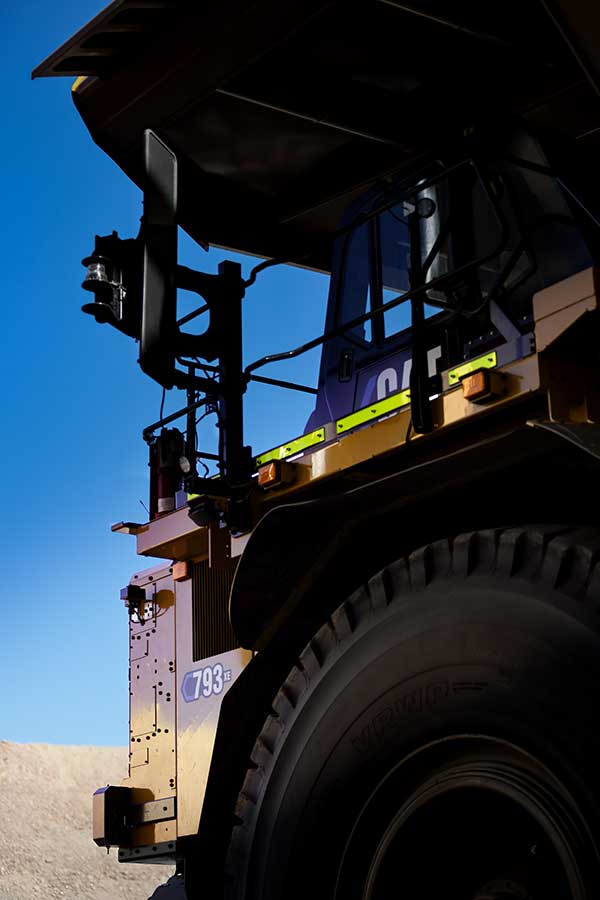
Sierrita has been in the process of testing a new battery-electric haul truck prototype since earlier this year.
“So many potential alternatives to mining technologies have not been proven at scale. What we’re seeing now is an effort to change that, an effort to work closely with our strategic partners in the mining industry, so they can provide us the resources we need for the future.”
JASON BOWSHER | LIFE CYCLE AND DECARBONIZATION MANAGER
“The heartbeat of innovation beats in Tyrone,” Gerdes said. “Here, we understand our partners are not always going to be able to produce the results we want when we want them. Once they do, we’ll be ready to talk about the future.”
Illustrative of that, Gerdes points to the fully electric forklift more recently tested at Tyrone’s SX/EW plant.
While not new technology, electric forklifts have made great strides since their early days. According to Gerdes and his team, these new forklifts run long, charge fast and lack the memory issues that once plagued rechargeable batteries and reduced their life.
Impressed by that performance and the increased availability afforded by reduced maintenance requirements, the team already has acquired a second unit and foresees a future in which these greener alternatives replace a majority of their fleet.
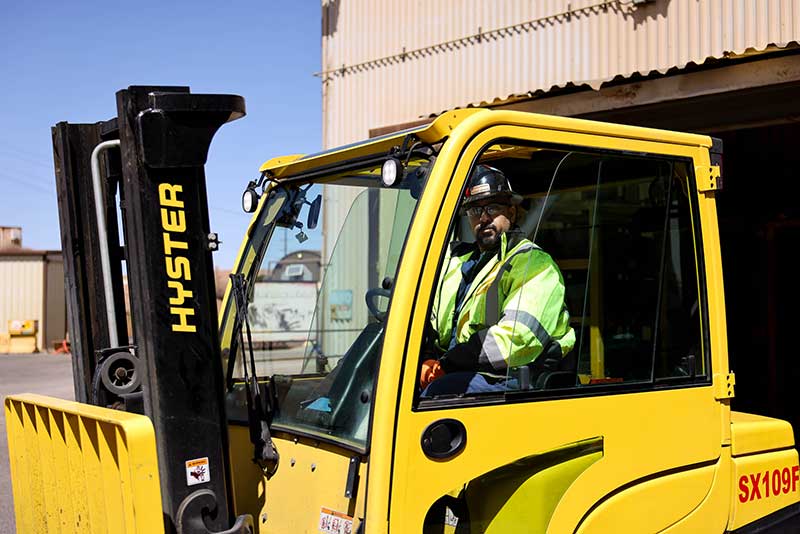
At a point when traditional forklifts develop issues, Richard Jemente, Hydromet EW Operator II-Tyrone, says the electric one is still going strong.
In some cases, the fleet already is in place for more widescale testing.
Multiple sites are piloting electric alternatives for light vehicles, not only testing them for day-to-day use in mines but also under the harsh temperature extremes that Freeport’s North America mining environments tend to offer.
At Climax, Colorado’s bitter winters pose an interesting test case for the mine’s 11 electric pickup trucks. Alex Ungers, Chief Environmental Scientist-Climax, said that while these light vehicles are performing satisfactorily, they do have issues taking and holding a charge in the cold.
For Ungers, though, the bigger challenge is maintenance.
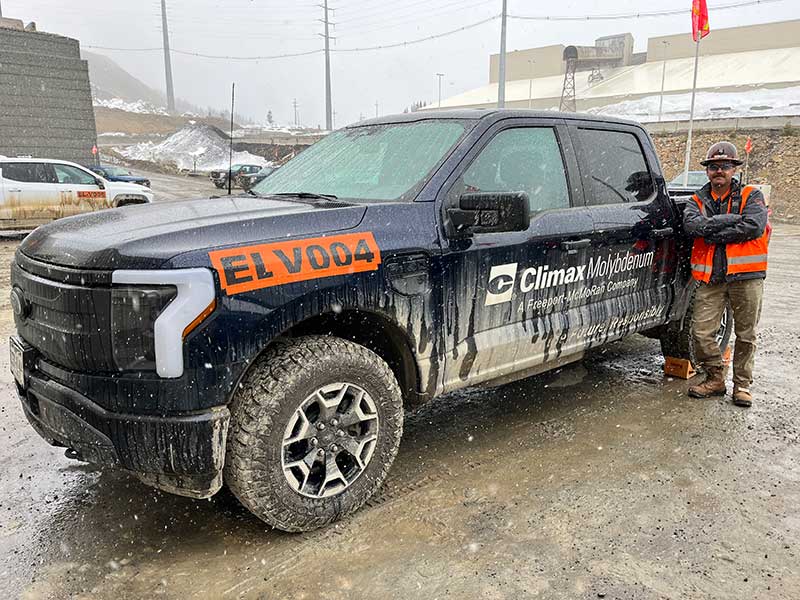
While they have their uses, the electric light vehicles being trialed by Alex Ungers, Chief Environmental Engineer, also have shown some limitations.
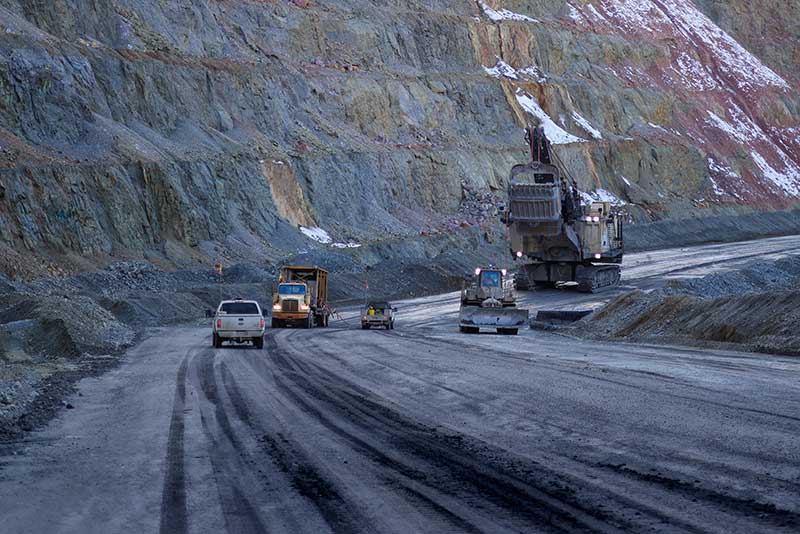
Though tethered to power cables even when moving, electric shovels long have been a fixture at Freeport.
While electric vehicles may avoid some service requirements of internal combustion engines, like oil changes, Ungers said even routine maintenance requires the trucks to be shipped to Denver. Because of unpredictable dealership maintenance queues, this can result in longer downtime than vehicles serviced on-site.
Ultimately, this forces Climax to be more judicious in how the trucks are used right now.
“The general cross-site commuters seem to prefer the EVs, while departments needing to access less-traveled parts of property struggle with the low-clearance battery undercarriage,” Ungers said. “I think our fleet has a place here, but it is about finding the right fit and grasping the maintenance of these new EVs so they can perform and last as long as traditional trucks.”
At Sierrita, which has a similarly sized fleet and two electric vans, Freeport is working with a company that specializes in electric mining vehicles.
Together, they are trialing two pickups with custom builds that include additional ground clearance, reinforced undercarriage shielding, and both on-site and remote support – all features that could one day address many of Climax’s concerns.
“We know the world is facing a problem, and we also know the role copper plays in its solution. At Freeport, doing our part isn’t a choice – it’s the job, and it starts before any copper even leaves those gates.”
JASON BOWSHER | LIFE CYCLE AND DECARBONIZATION MANAGER
For the decarbonization team, the disparity between the sites is by design.
Bowsher acknowledges that not every solution is going to fit every problem and requires a lot of trial and error. That means taking a broad approach that includes looking at a wide range of electric alternatives from a wide range of makers and service partners.
“Unfortunately, there’s no panacea here,” Bowsher said. “We know the world is facing a problem, and we also know the role copper plays in its solution. At Freeport, doing our part isn’t a choice – it’s the job, and it starts before any copper even leaves those gates.”
Local Steps, Global Strides
Electrifying mine equipment is part of Freeport’s broader strategy to decarbonize or reduce the amount of carbon emissions generated per ton of copper produced. Aimed at mitigating the potential impacts of climate change, decarbonization focuses on supporting the business as the world works to transition to a low-carbon future.
“Responsible copper production includes reducing the burden of our production processes while we reduce our operational costs and add value to the business through innovation,” said Brian Parkey, Climate Manager. “Our stakeholders – including investors, customers, markets and end users – expect us to demonstrate we are responsible producers. Our greenhouse gas reduction targets are a key piece of that work.”
Parkey is part of the “Climate Team,” a group tasked with guiding the company’s climate strategy. The team is working cross functionally with operations, technical services, environmental and sustainability teams to develop and implement projects focused on value-driven short and long-term decarbonization globally. Parkey noted that while different regions and divisions of the company have distinct challenges and priorities, sites can learn from each other’s successes and failures when collaboration is continuous.
The heart of the company’s decarbonization plan is focused on lowering emissions through energy efficiency, increased use of renewable energy sources, new technologies like battery electric
equipment or in pit crush and convey, and most importantly, innovation. Efforts like Leach to the Last Drop and Reinvent Mining will be crucial to helping the company achieve these reductions in greenhouse gas intensity.
Underpinning this work is the need to continue being the best at the basics – producing responsibly and meeting the company’s plans safely. By doing this, every employee at Freeport helps to secure the company’s future, Parkey said.
“Achieving production targets while integrating new technologies into our operations will help us achieve our goals,” Parkey said.
More information about Freeport’s decarbonization and climate strategy can be found in the 2024 Annual Report on Sustainability.
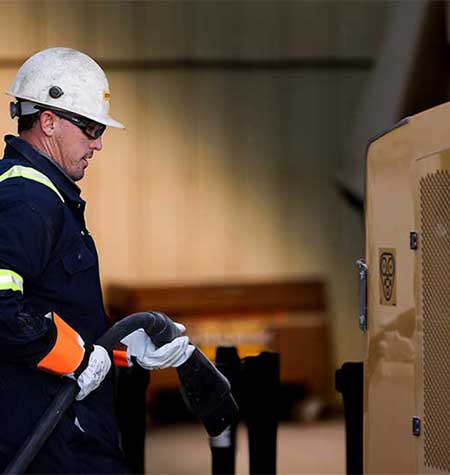
From standard chargers to dynamic, on-the-go solutions, Freeport is testing multiple ways to keep its fleet powered.
Charging Forward
As Freeport pushes forward with the trials for electric vehicles and equipment, charging solutions remain a primary consideration, and each site is tailoring infrastructure to meet its needs.
“It won’t be about just installing as many chargers as we can,” said Bismark Osei, Chief Decarbonization Engineer-FM Technical Services. “We have to ask questions about cost efficiency, how fast they can charge and how much the infrastructure can support.”
This was particularly important as Sierrita planned for its electric haul truck. There, the team started with a smaller unit at the truck shop with a substation closer to the pit that can charge in about half the time. Eventually, it may improve even further, with plans for a dynamic charging solution that replenishes its battery on the go – the perfect counterpart to Freeport’s 24-hour operations.