
VOL. 07 | ISSUE 1 | March 2024
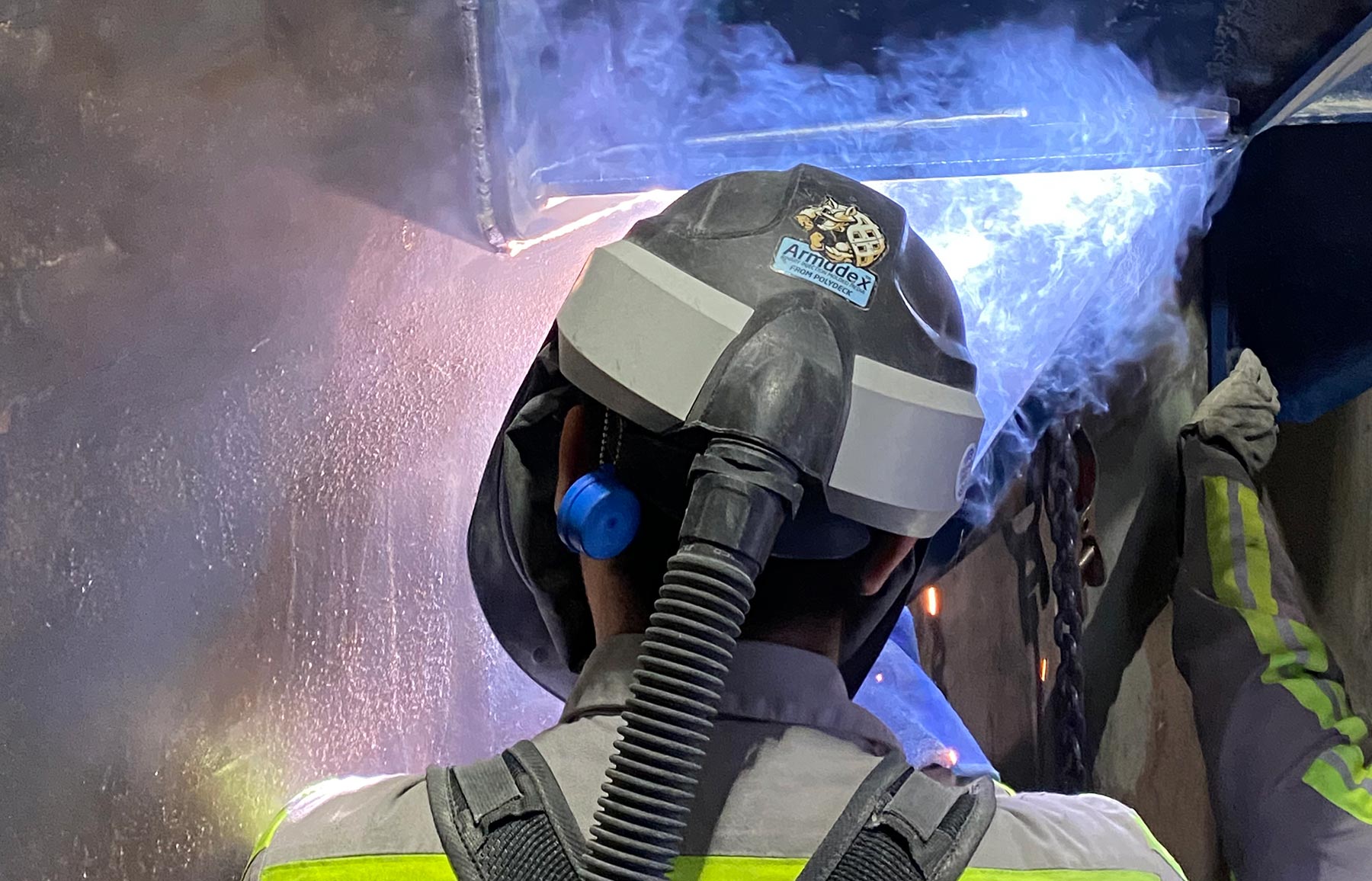
Gabe Leon, Crush/Convey Repair Employee, welds a drive line base for a discharge screen at Sierrita.
Innovative Maintenance Procedures Help Keep the Sierrita Mill Running at Peak Performance
Professional auto racing wouldn’t be so exciting if every pit stop required the driver to hop out of the car, fill up the tank with gas and change the tires before returning to the track. Pit stops have become a tightly timed orchestra of activity in which everyone on a well-trained crew has a specific task. So, rather than taking minutes, a top-level driver can resume the race in seconds.
That’s the idea behind a new way of doing maintenance and repairs to the crush and convey systems at the Sierrita mill. Like the racing team, the mechanics who keep the equipment running are on a tight timeline where seconds count. Winning for them means getting their work done without disrupting production by forcing a shutdown of the ball mills. This gives them about six hours.
To help ensure the big jobs get done on time, collaborative teams of mechanics, planners, site leaders and frontline workers have come up with innovative ways to identify, plan, schedule and safely execute the work that needs to be done, all in six hours or less.
The new way of thinking has paid off at Sierrita. Time wise, total annual disruptions to the mill were reduced nearly 90 percent in 2023, largely the result of more efficient maintenance and reliability procedures in crush and convey. That translates to about $48 million in production value.
Improving maintenance and reliability was one of the company’s supporting pillars in 2023 and is again this year. It’s achieved by managing equipment to minimize unplanned downtime through intense data monitoring, visual inspections and proactive analytics. When there are indications a part is wearing out, it is flagged for replacement during a planned shutdown for preventive maintenance rather than allowing it to fester and fail unexpectedly.
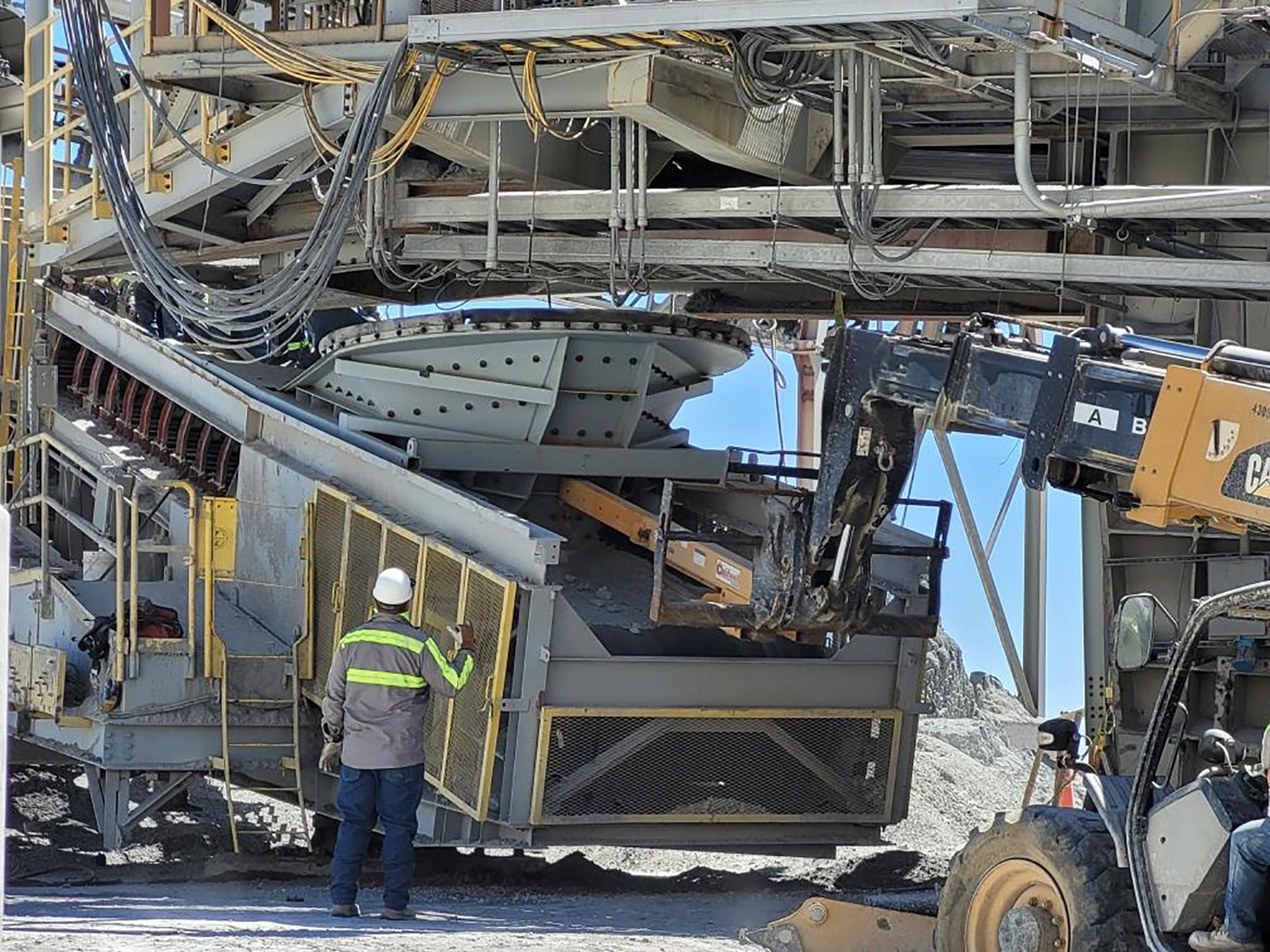
Workers install a conveyor transfer chute during a recent planned maintenance down day at Sierrita.
The new approach to maintenance and reliability at Sierrita has been in the works for a couple of years, said Jonathan Ruiz, Senior Supervisor-Crush/Convey Maintenance at Sierrita. In the past, there wasn’t much pressure on the Crush and Convey team to operate more efficiently because the mill only operated at about two-thirds of its capacity. Beginning in 2021, the mill underwent significant improvements in equipment and performance which raised its productivity. That identified shortcomings in the crush and convey network, which was unable to keep up as the milling operation improved.
To increase efficiency, the entire crush and convey operation was scrutinized, and old procedures were replaced with innovative approaches aimed at minimizing downtime at the mill, whether planned or unplanned. The magic number was six hours for all the work to get done.
The bottleneck at the Sierrita mill is the secondary crusher, which feeds material into a hopper that drops it into the 16 ball mills. The hopper can hold enough material to keep the mill running for about six or seven hours. If repairs to the secondary crusher or associated equipment take longer than that, the hopper will drain out, and the mill will shut down because there is no material for it to process, disrupting production.
Documenting the details
One of the simplest changes was to require detailed preventive maintenance plans, Ruiz said. Previously, they were vague, just blanket work orders like “do PM on the crusher.” They were a catchall for the routine jobs that had to be performed, regardless of whether the individual component needed maintenance.
Working closely with mechanics and frontline equipment operators, new maintenance schedules were developed based on the actual expected life of individual components. Now, preventive maintenance work orders specify what equipment needs service and what exactly needs to be done. That allows mechanics to pre-plan the job, make sure all parts and equipment are in place, and get any help they may need to do the work, said Jesus Peraza, Supervisor-Crush/Convey Maintenance.
Proper planning has led to significant reductions in the time it takes to do routine maintenance as well as complex repairs, said Ronnie Salcido, Certified Diagnostic Mechanic-Crush/Convey. One job he recently completed used to take eight to 10 hours, and through more efficient techniques, he was able to complete it in about five and a half hours.
“The planning on all your jobs is the main thing, the setup and all that,” Salcido said. “On a major job, we’re going to try to see if we can shave any kind of time off it from how we did it in the past. When we get those work orders in and a down day does come, we go straight through. What we need is already in the truck or near the jobsite. We are cutting a lot of time in that situation.”
Stretching the maintenance timeline
Part of the new approach also involves extending the maintenance cycles for equipment, where possible, based on actual wear conditions rather than fixed schedules or random chance, Ruiz said. By relying on the expertise of mechanics and equipment operators as well as data and other technical information on the life of various components, new preventive maintenance schedules have been devised.
In the past, individual equipment parts might have been serviced – or not serviced – as a matter of routine during a regular preventive maintenance shutdown, regardless of whether it was needed. Now, wear life is anticipated for the equipment and maintenance jobs are grouped based on that, which is more efficient and cost-effective, and lessens the chances a part will fail unexpectedly and cause a shutdown, Ruiz said.
In addition, an aggressive equipment monitoring regimen encourages all employees to report anything that could indicate a maintenance issue – things like unusual noises or vibrations, regardless how slight. Regular run-time inspections, made while the equipment is operating, are routine, and reports are filed on anything that might indicate a part needs service.
The number of monthly work orders tripled in the first six months of 2023, after the more aggressive monitoring began. Despite the increase, no preventive maintenance shutdown had to be extended. Instead, the intensive monitoring helped ensure problems were fixed and corrected early, Ruiz said.
“That’s just getting out there and finding the work and getting it into the system so our planners and supervisors can plan, schedule and execute,” Ruiz said. “It’s identifying the work before it causes you grief, unscheduled downtime or even lead to further catastrophic failure. One little thing has a domino effect that causes more issues that you’re going to have to encounter because you just didn’t take care of this.”
Critical pathway to success
Everything comes together in planning all the jobs that need to get done during a scheduled shutdown of the crusher and the network that feeds it. The job that will take the longest is designated the “critical pathway,” and the other work scheduled for the day must take at least 90 minutes less than that. This prevents any secondary job from causing unexpected delays that could lead to disruption of the flow of material to the ball mill, Ruiz said.
“These new ways of working have transformed Sierrita and sealed up our best operating performance in 25 years,” Ruiz said. “Crush and convey has embarked on an open and transparent team effort that celebrates wins but tackles challenges as a group. Having the entire team rally together on a common goal naturally puts you in the right position at the right time with the right people.”
Time-saving Innovations at Sierrita Include a Bucket of Bolts
As every backyard mechanic knows, the most frustrating part of any repair job is the wasted time spent picking around the workbench searching for the right tool or part.
The people who keep the crush and convey system at Sierrita running reliably have developed an innovative way to eliminate that headache, and it involves a bucket of bolts.
To maximize efficiency on maintenance and repair jobs, a mechanic often is paired with an assistant whose only job is to do any side chores not directly part of the hands-on work. That might mean keeping the workspace clean or retrieving tools. There even have been jobs where the assistant’s only task was to stand behind the mechanic with a bucket of bolts and hand them over as needed.
Having an assistant do the support tasks not directly associated with the repair frees the mechanic to focus solely on safely and efficiently doing the work, said Jonathan Ruiz, Senior Supervisor-Crush/Convey
Maintenance at Sierrita.
While handing bolts out of a bucket might sound trivial, an analysis showed that on a particular 10-hour job the mechanic spent about 40 minutes just getting the bolts that were needed. Having an assistant do that can trim those 40 minutes off the time it takes to get the work done, helping ensure the shutdown associated with the repair is finished without disrupting production, Ruiz said.
“That 40 minutes is enough time to not curtail the mill,” Ruiz said. “Anything you can gain back time with is what we are trying to achieve. We didn’t bypass any safety controls. We actually made all the jobs we’ve done in this process safer just by doing things differently.”
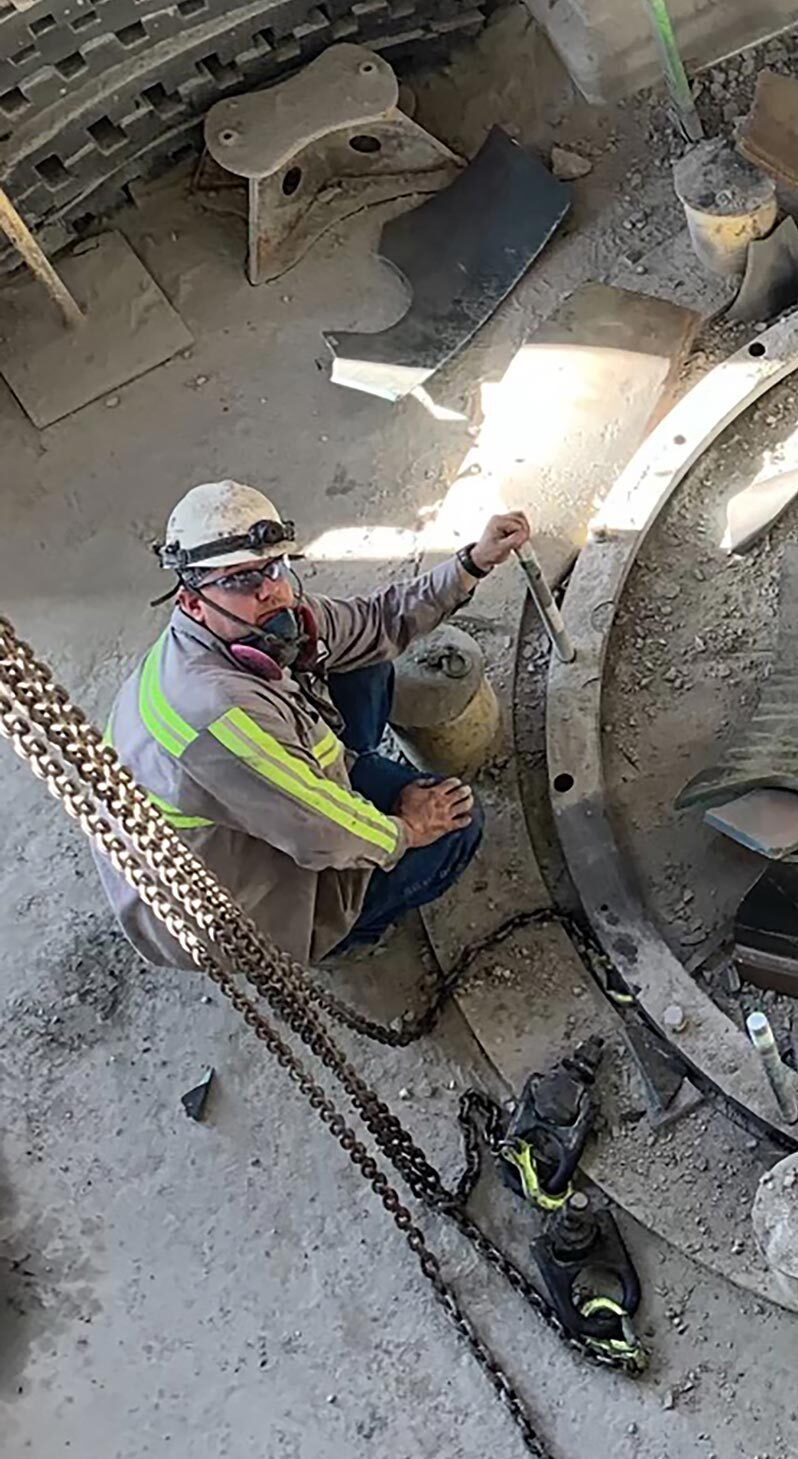
Anthony Burruel, Crush/Convey Diagnostic Mechanic II, services the support ring to a hydro cone crusher.