
VOL. 08 | ISSUE 3 | Fall 2025
Freeport’s
Rod Rebound
Freeport's
Rod Rebound
Cultural Shift Brings Operation Back from
Depths of Pandemic, Economic Downturn
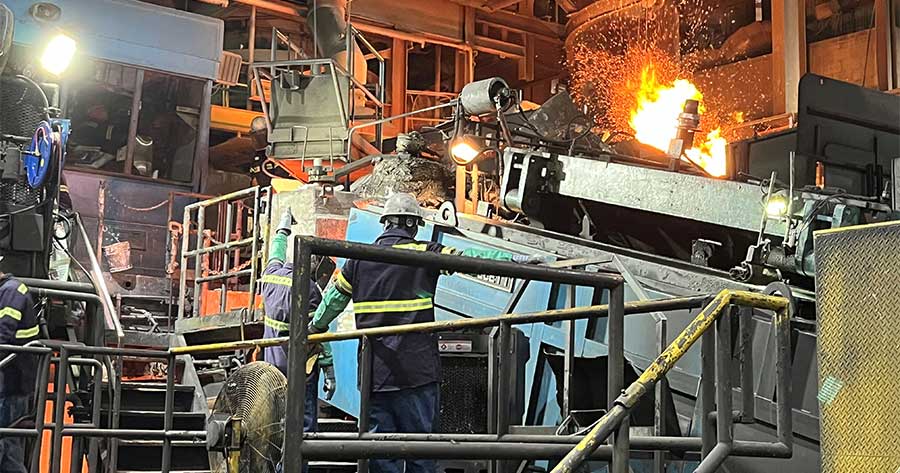
At the El Paso rod mill, the way teams approach maintenance has undergone a quiet but powerful shift. Where once the focus was on keeping things running with quick fixes, the culture has moved toward long-term reliability.
Now, worn parts are identified and replaced before they fail – a proactive mindset that keeps operations steady and downtime low. It’s an approach that mirrors the proven strategy at Freeport-McMoRan’s Miami rod mill, where preventive maintenance has been the foundation of performance for more than a decade.
“It is very much proactive the way we are doing things nowadays,” said Gerry Parra, Certified Diagnostic Mechanic, who has worked at the El Paso rod mill for 29 years. “Back in the day, we were craving for maintenance days because we knew certain equipment was getting ready to give out, and we would run it until it died. Now, we don’t let it break. We change it beforehand. No rush. This has to be done right.”
This fix-it-before-it-fails approach to maintenance has paid off. Last year, the El Paso rod mill reduced unscheduled down time by 15.7 percent and produced 19.4 million more pounds of saleable copper compared with 2023.
Miami has exceeded industry standards for reliability every year since 2016.
Combined, the two plants delivered more than 1 billion pounds of saleable copper last year.
Preventing equipment breakdowns through a focus on Maintenance and Reliability is one of Freeport’s Strategic Themes for North America, five critical objectives that drive the company to safely achieve its 2025 production targets by being the best at the basics.
The success of both rod mills is due to a focus on preventing equipment failure rather than reacting to it, said Roger Laija, General Manager-Rod and Refining. Laija has been in charge of the Miami plant since 2013 and assumed management oversight of the El Paso facility earlier this year.
Preventive maintenance avoids unplanned down time, Laija said. That improves safety, reduces costs and delivers more production over the long run.
“The efficiency of the two mills has reached a point now that we have surpassed what we would consider world class,” Laija said. “The efficiency of these mills has truly gone through the roof. There’s been a lot of focus on the fundamentals, on the basics, on ensuring that we don’t run to fail and that we build plans on component changeout.”
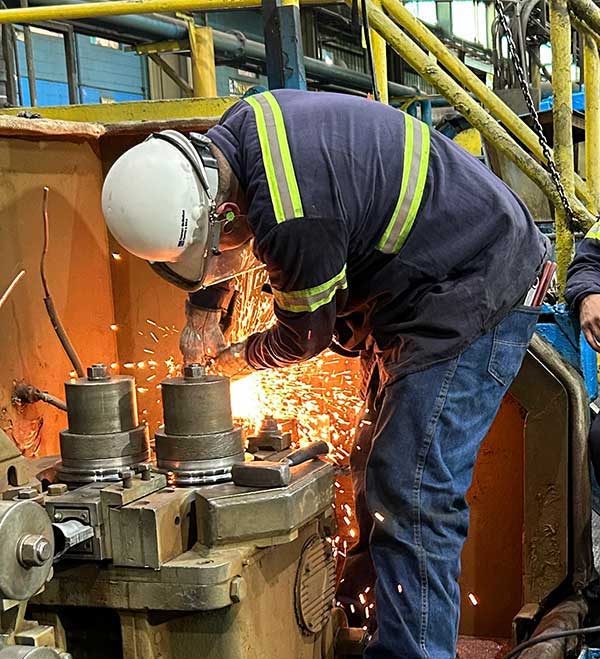
Alex Gamon-Mechanic, installs a new entry tube into a cooling line at the El Paso Rod Mill.
Pursuing peak performance
The push for peak performance at the rod mills goes back to the COVID-19 pandemic five years ago. At the time, Freeport was operating three rod mills: El Paso, Miami and one in Norwich, Connecticut.
The mills are Freeport’s final stage of production before delivering its finished product to customers – 7,200-pound spools of copper rod that is 99.99 percent pure that has been stretched to a thickness of five-sixteeenths of an inch.
The pandemic and ensuing economic downturn increased pressure to reduce costs and improve efficiency, leading to the closure of the Norwich plant in 2020. As the economy rebounded, so did the demand for the copper rod, which is vital for today’s global economy and for future electrification needed to support things like electric vehicles and data centers for artificial intelligence.
The challenge after the Norwich closure was to ramp up production at the two remaining mills to meet demand without compromising the company’s high standards for safety, quality, reliability, and customer service, said Randy Nickle, Senior Vice President, Sales and Marketing. The El Paso and Miami plants had to become more efficient.
“Freeport had to respond in support of the industry,” Nickle said. “To maintain our market leadership position – the only position Freeport knows – our plants would have to be the safest, best-run rod mills on the planet. The Miami and El Paso teams would have to operate the plants at higher utilization rates than had been achieved in decades. They’d have to do it safer than ever before and without sacrificing quality or service.”
Last year, the El Paso rod mill reduced Unscheduled down time by 15.7 percent and produced 19.4 million more pounds of saleable copper compared with 2023.
The Miami model
Nickle assembled a team to wring the most out of the remaining two rod mills. With help from Freeport’s Operational Improvement group a “new focus on fanatical consistency” was instituted to remove unnecessary variability and identify the most meaningful improvements, he said.
Miami’s success was the model.
Alejandro Valadez, Manager-Operations Support, was put in charge of the El Paso mill in March 2023. The same rigorous preventive maintenance procedures that proved successful in Miami were implemented at El Paso.
An obsolete and unreliable hydraulic system which accounted for about a third of unscheduled delays was replaced at a cost of $1.7 million. That investment quickly was recouped because of enhanced plant reliability.
The team developed and implemented a world-class preventative maintenance schedule, which it follows like clockwork to replace components before they fail, refresh fluids, and inspect critical components. The teams know that safety, quality, and customer service begin with a well maintained and well operated plant.
Now, worn out parts are discarded, and an inventory of new replacements is maintained. When a critical part like a motor does fails, it is carefully inspected in an “autopsy” to determine why.
Last year, the El Paso and Miami rod mills produced almost as much saleable copper as the three plants produced before Norwich closed, and they’re on track again this year to produce even more.
“It was a cultural change for us,” Valadez said of the shift to preventive maintenance. “The old attitude was keep it running until it breaks, and even if it breaks, keep it on hand in case the new one breaks. Now, the attitude is we have a lot of understanding of the parts and their life cycle, and we’re not going to let it get to that point.”
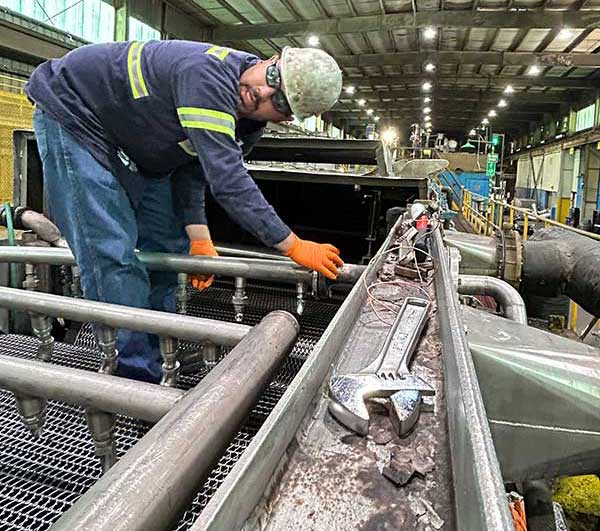
Luis Avalos-Rod Mill Production Operator Trainee, conducts final checks on the conveyance system at the El Paso Rod Mill.
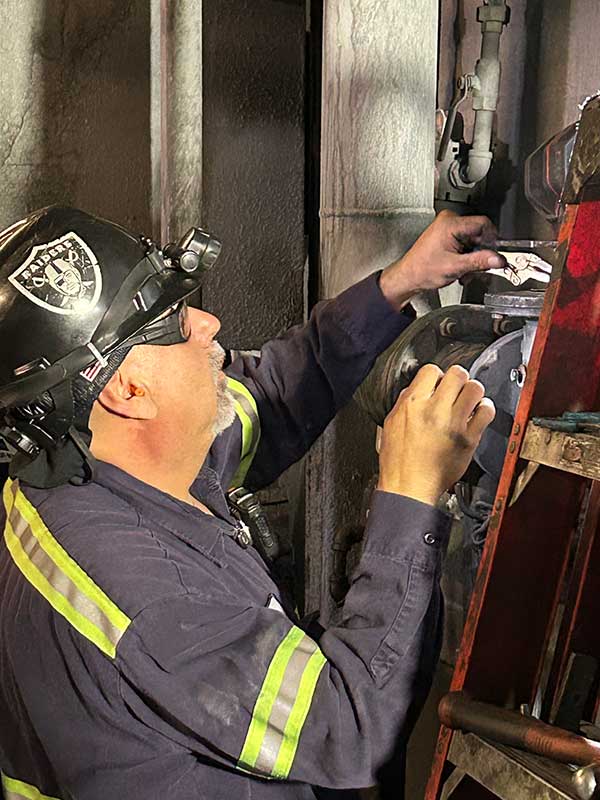
Jose Gallardo-Senior Tribology Technician, works on a valve during a recent planned maintenance shutdown at the El Paso Rod Mill.
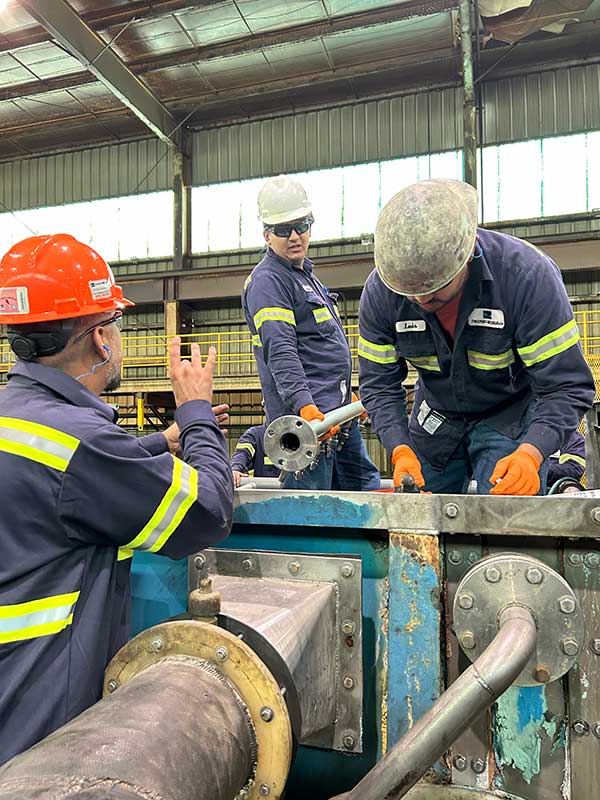
Chris Navarro-Operations Helper (left), Martin Chavez-Rod Mill Production Operator Trainee, and Luis Avalos-Rod Mill Production Operator Trainee, conduct maintenance on the piping for the conveyance system at El Paso.
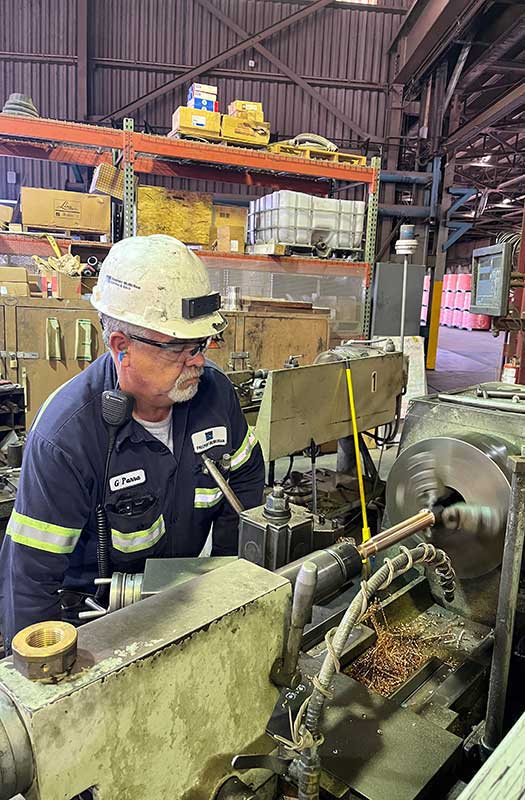
Gerry Parra-Certified Diagnostic Mechanic, machines sample holders for lab inspections at the El Paso Rod Mill.
All in a Day’s Work
Getting a call from an original equipment manufacturer’s representative asking how to get the most out of its own machinery might seem unusual to most industrial plant operators.
For Roger Laija, General Manager, Rod and Refining, it’s just another day at the office.
Laija’s approach to maintenance is what he calls a 20-year mindset. It focuses on what it will take to keep equipment running for the next 20 years rather than just getting through the day without a breakdown.
Equipment is replaced on a predictive schedule rather than after it breaks.
The approach proved successful at the Miami plant, which Laija has been running since 2013. Over the past nine years, the Miami rod mill has delivered operational efficiency rates of between 95 and 99 percent. The industry standard of what is considered “optimal” is 92 percent.
Laija attributes the success to increased reliability that comes from preventing breakdowns rather than fixing them.
Historical data is analyzed to predict the anticipated lifespan of individual parts like motors, and they are scheduled for replacement before they fail, even if they are still working at the time.
Reliably Centered Maintenance teams regularly inspect critical components for warning signs like vibration, noise or excessive heat that could indicate a part is about to fail and needs to be flagged for replacement during scheduled down time.
Parts showing signs of impending failure are replaced during regular preventive maintenance shutdowns, which is far safer and less expensive than waiting for them to fail.
“You don’t run an airplane, and say it’s time to change the motor when it’s falling from the sky,” Laija said. “That has allowed us to be more efficient, to increase the output just by running a smart business and using planned maintenance instead of running to fail. Instead of chasing pounds, we chase reliability and repeatability of the operation. Because of that, we are able to deliver the pounds and then some.”