
VOL. 08 | ISSUE 3 | Fall 2025
Degrees of
Separation
Application of Heat Driving Improved
Leach Recovery
It started with a mid-December email in 2022.
It ended with the realization that within a 12-page document, there existed a roadmap for Freeport’s future.
Officially, it was known as “Incremental Cu Recovery based on Temperature and Mineralogy for Leaching Operations at Freeport.”
Unofficially, “The Heat Memo.”
It distilled years of field and lab tests into a single reference point, charting copper yields by temperature, method and mineralogy, giving the company the clarity to envision transformative approaches toward recovery efforts.
Now, almost three years later, Freeport stands on the threshold of the door that insight opened, with a wave of stockpile experiments about to begin. And while these projects are scattered across the map, they all originate from the same point: More heat produces more copper.
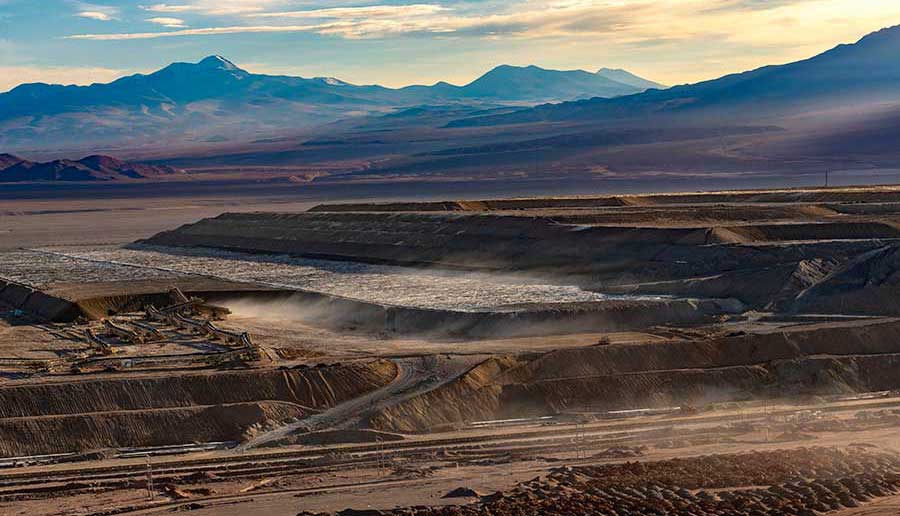
El Abra’s SulfoLix Phase 2 is one of two South American projects coming online in 2026.
“We’ve always known heat was an important lever in leaching,” said Robert Crossman, Operational Improvement Manager. “The Heat Memo represented a massive step forward in how we utilized that lever. The Leach Excellence Center quantified our data in a way that allowed us to develop clearcut business strategies.”
With close to two decades in mining and metallurgy, Crossman helps determine Freeport’s leaching opportunities. When it comes to the idea of heated raffinate – solution pre-heated to boost reactivity and recovery – Crossman sees a big opportunity.
More to the point, others see it as well.
The Heat Memo showed projections of almost a full percentage point or more of additional recovery for each degree added. Those were the sort of recovery rate projections needed for a paradigm shift to convince people the challenge of “heating a mountain” was worth taking on.
And it is a shift meeting both the moment and the mission, Crossman explained, with leaching never being more important.
As copper grades decline in established deposits, traditional operating practices no longer are viable. Reprocessing previously mined copper offers quicker and cheaper production, but much of it already has been leached, requiring new extraction methods. By adapting to this challenge and leveraging improved technology, the company is turning what once was deemed unrecoverable into tomorrow’s motherlode.
That’s why things are really heating up for Leach to the Last Drop going into 2026.
“We have three projects that could open the door for improved strategies built on lessons learned instead of assumptions,” Crossman said. “And there’s a lot of interest and support in this technology, from executive leadership to the sites to other key players in the industry. That gives us a lot of confidence that we’re on the right track.”
Arizona will set the stage for heated raffinate, starting with a surface leaching trial beginning at Morenci’s Lone Star stockpile later this year. Boilers will heat raffinate before it’s applied via standard irrigation. While similar to traditional leaching, instrumentation will measure heat transfer – how much, how long and how deep – at scale.
In the third quarter of 2026, focus will shift to South America with SulfoLix Phase II at El Abra. Heated solution will be applied to freshly crushed ore in sections, each held at temperature for about 30 days, allowing Freeport to validate models on new placements.
Later in 2026, Cerro Verde will test new heating technology and add heat subsurface into drill holes. The test uses downhole injected heat to track how far heat propagates from wells. The heat will be introduced via submerged combustion—firing gas burners into the raffinate to eliminate boilers and heat exchangers, aiming for more efficient heat transfer.
Given the scale of engineering and operating commitments for the three projects, it’s clear the company expects the investment to pay off. However, it isn’t putting all its eggs in one basket.
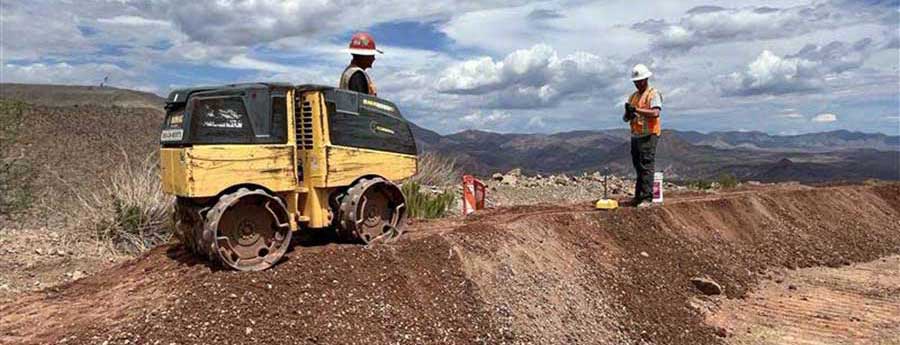
Ahead of the first heated raffinate test, Morenci employees prepare the Lone Star stockpile for installation of natural gas lines and boilers.
While some sites, like the leach-only Tyrone, are potential candidates for heated raffinate, others are continuing to use covers and other tried-and-true solutions.
And one site is taking an all-inclusive approach.
Referred to as the “Perfect Stockpile,” North Lampbright is Chino’s first new stockpile in decades and represents a considerable investment that could have an equally considerable payoff.
The stockpile incorporates years of learning into a single project, leveraging everything from air injection to Chino’s high pyrite concentration to raise the temperature, said Jose Carrasco, Senior Project Engineer-Chino.
More than just being a feat of engineering, the project represents an opportunity to validate models from a rapidly approaching Day 1, Carrasco said. Breaking ground last year, the project recently finished its 7.2-million-ton foundation pad, with pregnant leach solution impoundment and other milestones expected later this year.
The team expects the first leachable pounds to be placed early 2026, with final project completion in April.
“I think what we’re about to see is the culmination of a lot of effort,” Carrasco said. “Not just here, but across Freeport. Chino, Morenci, South America—one day, we’ll look back and say these are the places where we stopped talking about the future and started building it.”
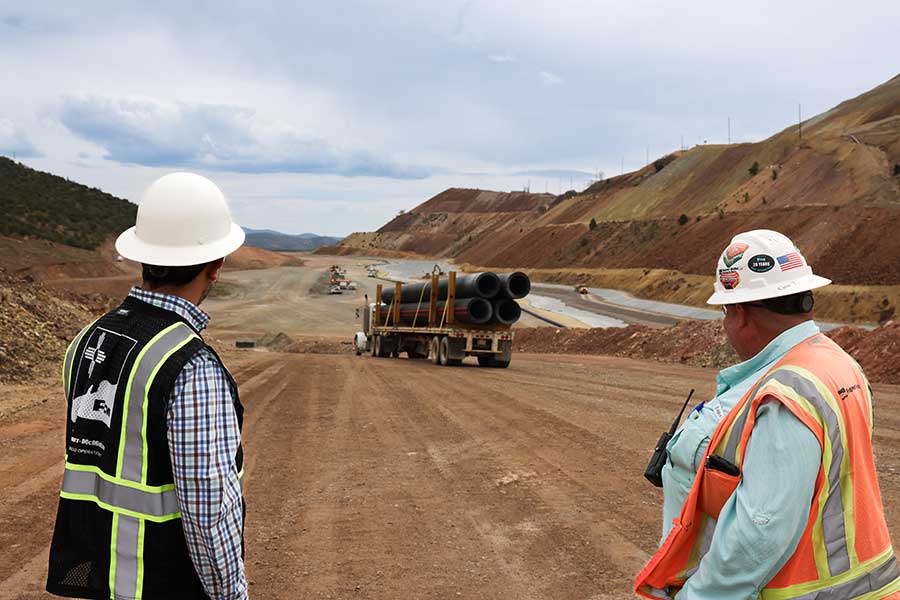
Jose Carrasco (left) and Yancey McCauley, Senior Supervisor Shared Services Special Projects-Chino, look on as more materials are delivered to Chino’s “Perfect Stockpile.”
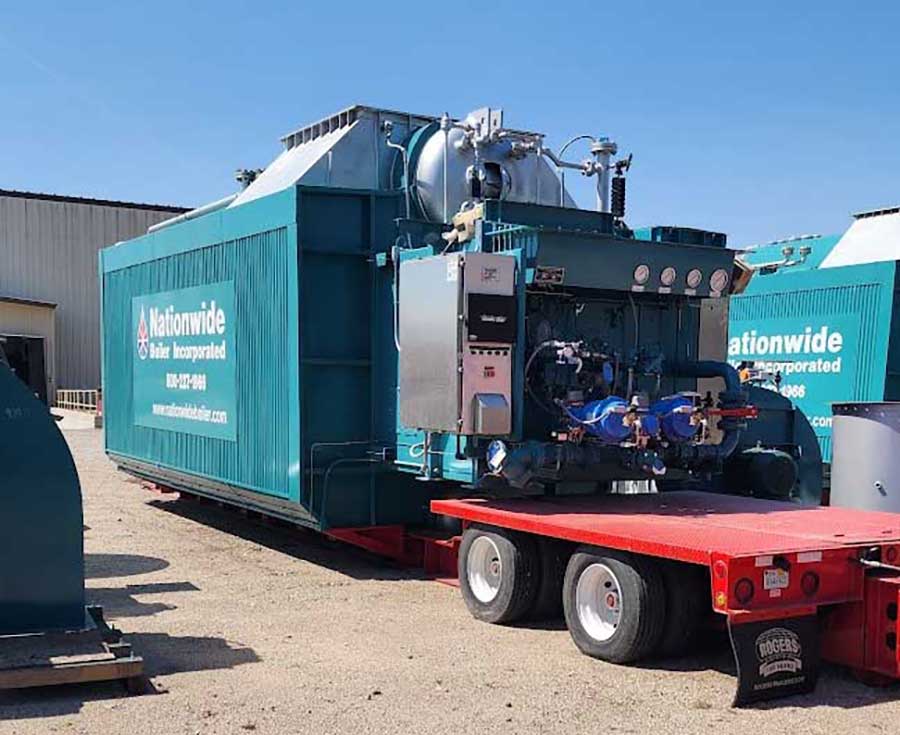
Boilers and other solutions are used to heat raffinate temperature.
Quarter
2025
Quarter
2026
Quarter
2026