
VOL. 08 | ISSUE 3 | Fall 2025
At the
Intersection
Cory Stevens Discusses the Importance of
Reinvent Mining to the Company’s Future
As the calendar moved into 2025, Freeport employees again were asked to strive to be the best at the basics – this time while also keeping an eye toward the future.
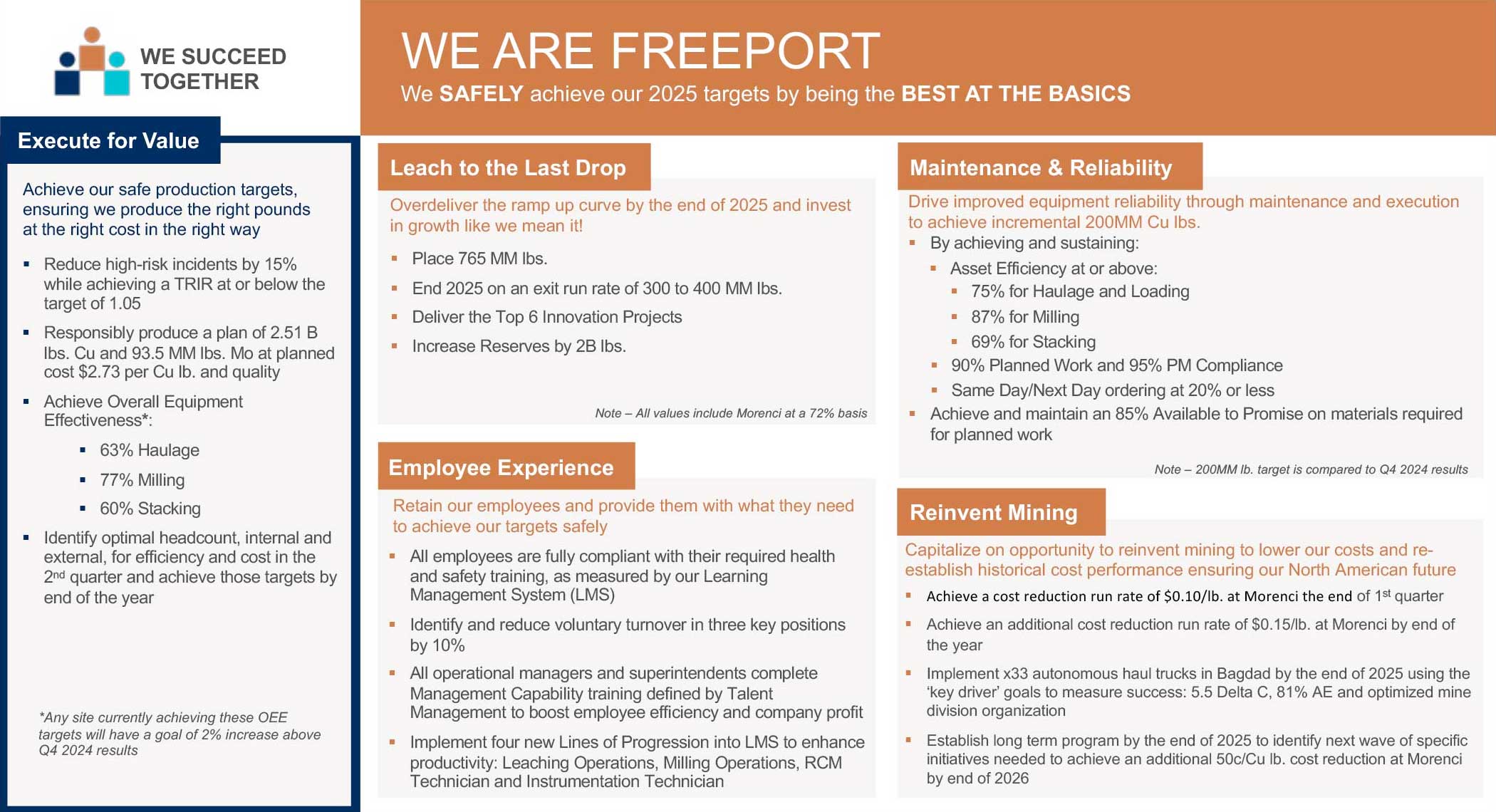
Introduced among the existing pillars was a new one: Reinvent Mining, a comprehensive approach to mining that re-evaluates the old way of doing things to improve production, cut costs and help ensure long-term competitiveness as an ore body evolves.
The goal is to analyze the entire mining process to identify the best approaches to create efficiencies and maximize value over the long term. Nearly a year into the effort, Cory Stevens, Senior Vice President and President of Technical Services, took time to discuss early outcomes, the changing dynamics of the company and the roll employees have moving forward.
We’re nearly a year into the introduction of Reinvent Mining. How would you assess the rollout thus far?
It’s taken a bit of time to get organized, but a lot has been accomplished. We’ve developed a stage-gate process to move ideas through discovery and implementation. We have several streams of work that focus both on day-to-day efficiencies, as well as evaluation of bigger investment decisions that could be step changes in terms of value. Data and collaboration are making a difference daily in terms of driving performance in alignment with our 2025 goals, while we work in parallel to set ourselves up for the future.
On the development side, quite a bit of work has been done on understanding how we can go after reducing costs in our haulage fleets. Haulage represents more than 20 percent of the operating costs and is a key focus area. We’re moving forward on trials with some bigger, ultra class trucks at Morenci. These trucks can move over 400 tons per payload compared with the 260 tons we move today. Cerro Verde has been running a few of these trucks for a couple of years, and we are taking some of their learnings to help with this decision. We are optimistic about where this potential can take us.
Introduced among the existing pillars was a new one: Reinvent Mining, a comprehensive approach to mining that re-evaluates the old way of doing things to improve production, cut costs and help ensure long-term competitiveness as an ore body evolves.
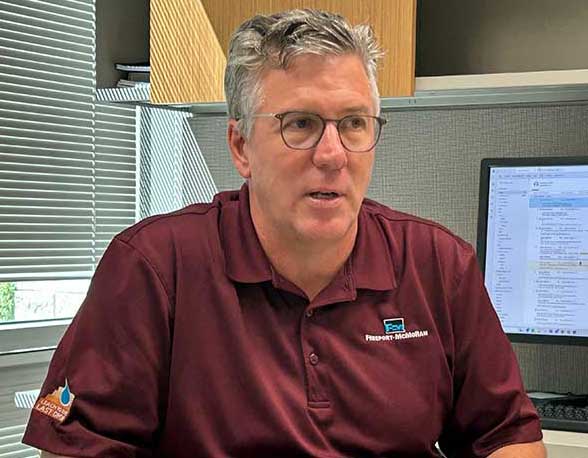
“Reinvent Mining is more of a mindset than anything else.”
CORY STEVENS | SENIOR VICE PRESIDENT & PRESIDENT OF TECHNICAL SERVICES
Then there is the Integrated Remote Operations Center or IROC that’s really taking shape at the Zone in Phoenix. We now have people permanently employed through that effort. That team is dashboarding activities, establishing communications protocols and regular touchpoints with sites to determine what success can look like. The idea is to supply folks in the field with all the data they need to be successful and ensure their best day every day. Key focus areas right now surround payload, fragmentation and our Remote Asset Management Program.
And, of course, we are looking closely at how we are applying technology around AI to identify where we may use it on projects like the autonomous effort in Bagdad.
For many in the company, the concept of Reinvent Mining is new. How do you define it?
Reinvent Mining is more of a mindset more than anything else. It’s about maintaining a high standard for our performance, but also never being quite satisfied with the result because we can always do it better. It’s about adopting new technologies, new business aspects and capabilities that we can build into our people to drive value and create longevity for the mineral resources we manage and help us all provide for our families. When you start thinking about what might be possible, sometimes we can do it a lot better
From all the work you just described, it’s clear the company is at a critical stage. What factors have put Freeport – and the entire industry – in the position of needing to make such dramatic shifts?
We are at a pretty interesting intersection. We’ve never seen a forward-looking view where our product and the services we provide have been in such demand. We have a tremendous opportunity. Of course there are challenges, but equally, current technologies and state-of-the-art equipment enable innovation that will allow safe production to continue for the next generation.
We have been great at execution and our operating performance has allowed us to compete more broadly. As our mines have evolved over the decades, there comes a time when both the equipment and business needs must also evolve to keep us competitive. These improvements will allow us to be safer, more efficient and enable quicker decisions made in real time to add value. This is what we are expecting with increased digitalization and AI helping our operations.
Change can be difficult, and as the company incorporates new technologies and better efficiencies, the need for certain jobs may evolve. How should employees view this shift in the business and how it may affect them individually?
That’s a great question. When we started down the path of autonomous haulage for Bagdad, we put quite a bit of thought into making sure that people impacted by the technology were able to be retrained or reskilled to stay with the company. We were very intentional about this.
It was really important that if employees wanted to continue to be part of the organization in a positive way, we were very empathetic. So, if they wanted to remain truck drivers, we could transfer them to another location where they could keep doing that work. Or, we could upskill them in a way that would enable them to work on autonomous trucks or maybe work in another area of our business. This is not about eliminating headcount. We want to expand and grow the company. If we do this right, we’ll be adding people by building capabilities going forward, not reducing.
We are working to create an environment where everyone feels valued and knows they are part of the solution. We don’t want them feeling like they are here simply to help us implement technology.
As the work supporting Reinvent Mining accelerates, how will leadership define success?
There definitely are key performance indicators we watch around whether payload looks better, whether fragmentation is improving and whether crusher throughputs are at the right levels. As we forward, I think there will be a greater level of acceptance as the business model changes, and we continue to educate people about this work. People will start to feel part of the effort and see their ideas being accepted. That will be critical to the success of the effort.
How important is it for employees at all levels to be engaged in the Reinvent Mining effort?
The people on the front line see what is happening day in and day out, so they know more than most of us. Anyone can make a difference. I know it can be difficult in terms of navigating the channels for providing feedback sometimes, but that’s where we want people to challenge the paradigms and speak up about their ideas. We are working to develop new channels for employees to provide that input, but I would highly encourage people to continue sharing ideas with their supervisors that can make us better. My message to those supervisors is to help ensure those ideas are reaching the right people so they can be considered.
This is a bit of a personal question, but what have you learned from your involvement with Reinvent Mining so far?
Communicating more broadly with the rest of the organization about what is going on in the various work streams is critical. I take it for granted sometimes and assume people know more than they might. In today’s day and age, we have lots of communications channels, but it seems like it is harder than ever to get the message out. Ultimately, we want everyone to own the message in a way they feel empowered to act on Reinvent Mining and know they are making a difference. That’s what we will continue to drive for.
“The people on the front line see what is happening day in and day out so they know more than most of us.”