
VOL. 07 | ISSUE 1 | March 2024
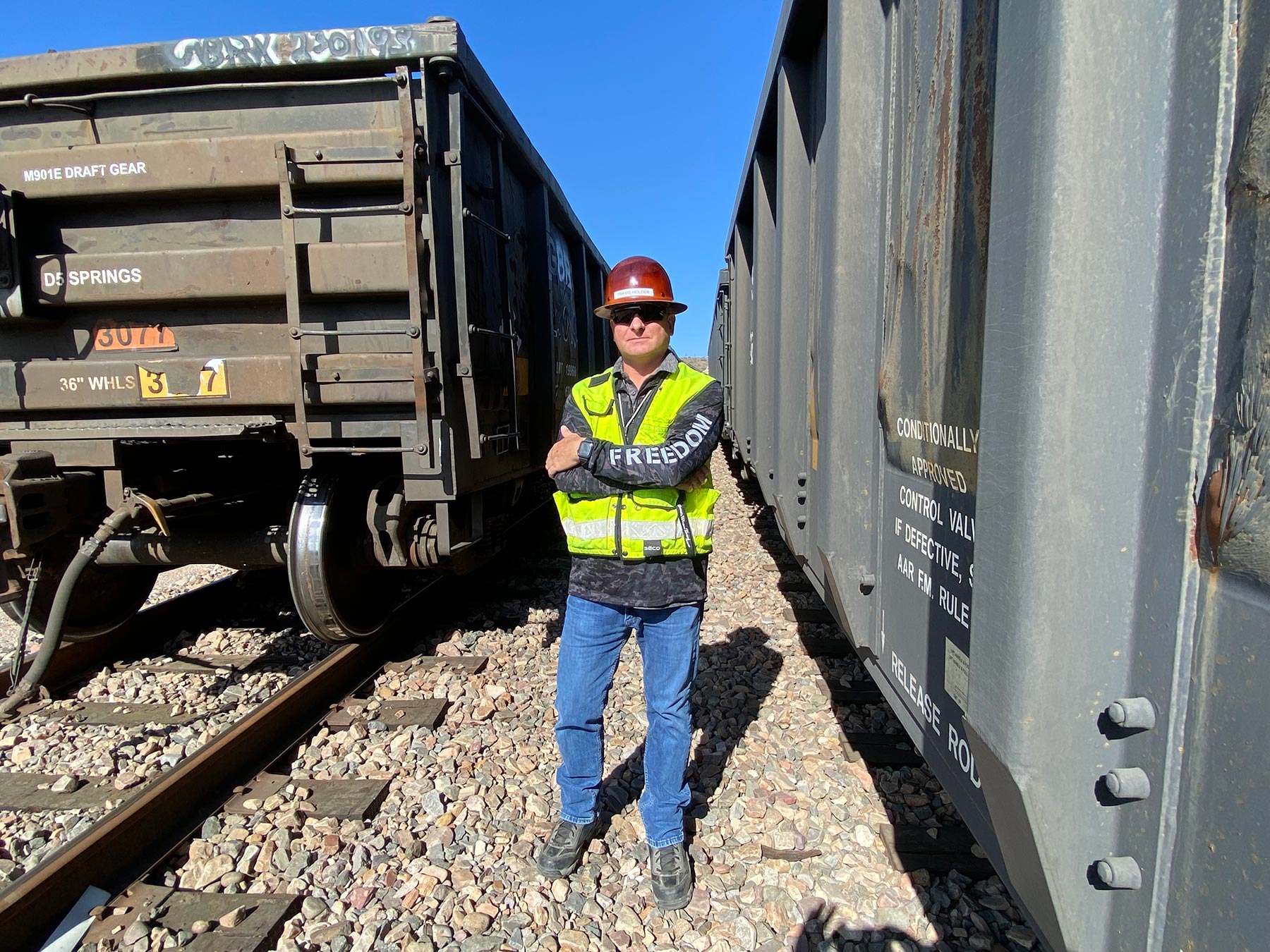
Travis Holder, Senior Supervisor-Smelter Transportation, is flanked by long rows of rail cars that bring copper concentrate to the Miami smelter.
Miami Smelter Undergoing Rail Revamp to Avoid Gridlock
All roads lead to Miami when it comes to logistics for Freeport-McMoRan’s operations in the Southwestern United States. And those roads are jammed.
But the Miami operation is undergoing a multi-phased railroad expansion that will avoid transportation gridlock in the short term and eventually allow it to load and ship the sulfuric acid needed to sustain company mines in North America on trains rather than trucks.
A new rail yard has been added east of the smelter that will allow more efficient movement of train traffic into and out of the site while adding storage space for about 100 rail cars. Before completion of the $2.5 million project, there was almost no leeway in the system to move cars around or take them off the main tracks to await loading or unloading, said Mark Albertsen, General Manager-Miami.
This was less of an issue several years ago when the smelter was processing 600,000 to 700,000 tons of copper concentrate per year and shipping a like amount of sulfuric acid, a byproduct of the smelting process which is vital to the leaching operations at other sites. Now, the facility is approaching its maximum permitted level of processing 1 million tons of copper concentrate per year. Running the transportation system so close to the margin is not acceptable given it is the vital hub for the company’s entire North America copper operation, Albertsen said.
Another $11.3 million rail project is planned for 2026 that will allow sulfuric acid to be loaded directly onto rail cars in Miami. The site lacks that capability now, forcing the acid to be transported by trucks, which is not as safe or cost effective as moving it by train. The ever-growing volume of truck traffic hauling hazardous acid, concentrate, anode, cathode and rod is a strain on the company’s relationship with its neighbors in Globe and the San Carlos Apache Tribe, Albertsen said.
“As we are driving to get to that permit level of 1 million tons, truck traffic increases, rail traffic increases, and storage of rail cars becomes an issue,” Albertsen said. “We have upwards of 120 or 130 trucks of acid being shipped out a day and a similar amount of concentrate trucks coming into the property. Moving it by rail is easier for us to handle.”
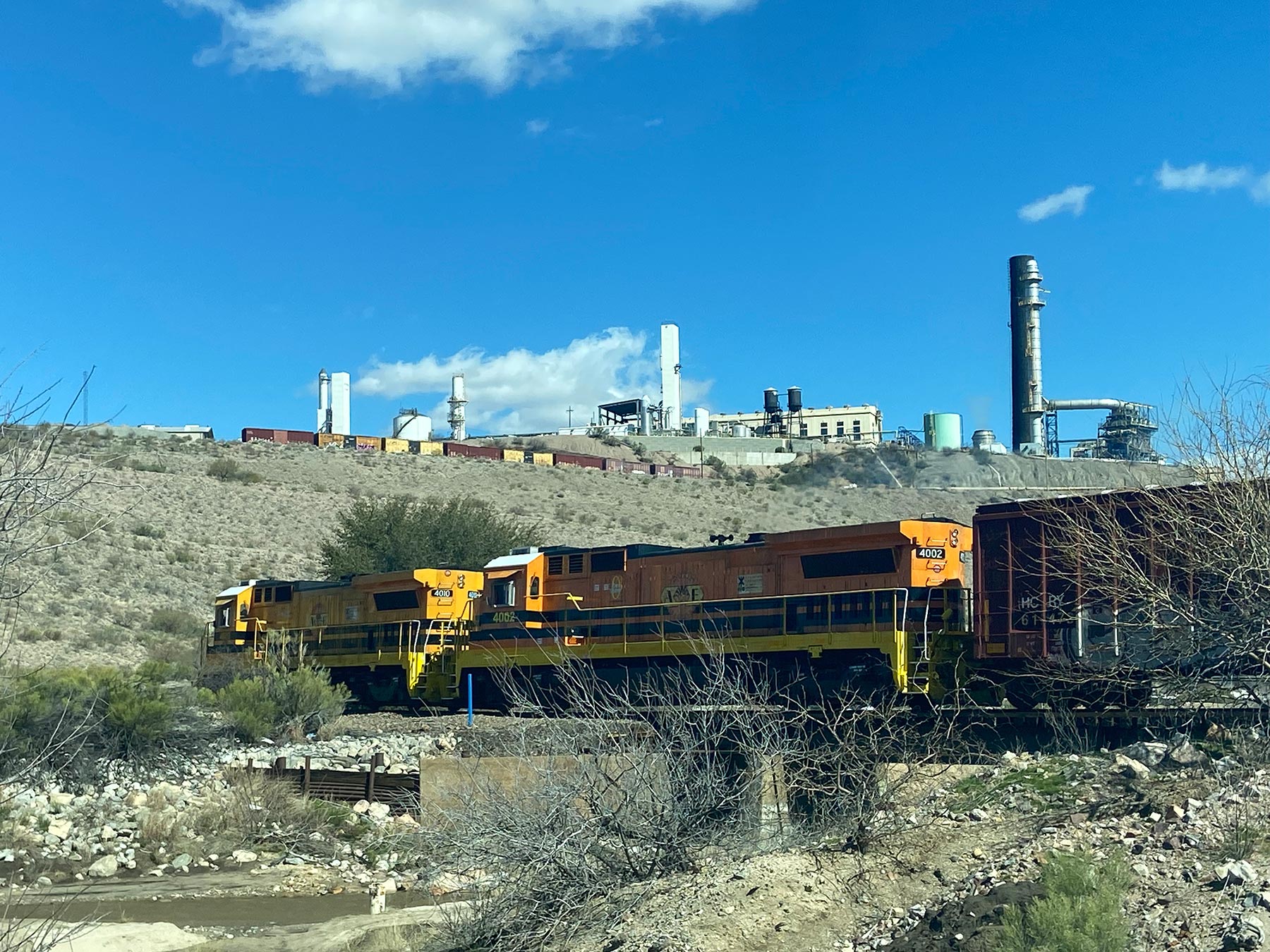
Rail and truck transportation at Miami is critical to the site and the company’s North American operations.
Center of the universe
Logistically, Miami is the center of the universe when it comes to Freeport’s copper production in North America. It is one of only two copper smelters still operating in the United States, and the only one owned by Freeport.
Every day, about 3,000 tons of copper concentrate from Freeport mines in Arizona and New Mexico are shipped to the Miami smelter for processing into anode. It comes in through a mix of trucks and train cars from Sierrita, Morenci and Chino and by truck from Bagdad which has no rail spur. A like amount of sulfuric acid is produced in the smelting process. What is not used in Miami is shipped out to support leaching operations in Safford, Bagdad, Sierrita and Morenci.
Safford is by far the biggest consumer of acid from Miami, which produces about half the amount used at company sites in the region. The rest is purchased, which is expensive and creates its own logistical problems when transported to the mines.
On a typical day, about 100 trucks enter Miami filled with concentrate and other materials to support the operation. Another 100-plus trucks leave the site carrying acid, which means there are normally 200 or more trucks passing through daily.
Then there’s the rail traffic, which also averages 80 or more cars per day. Aside from the copper concentrate, the trains bring empty box cars. Those get loaded with copper anode produced at the smelter that are shipped to the company’s refinery in El Paso. Copper cathode produced at the mine sites also is trucked into Miami’s rod mill.
The Miami rod mill produces about 1 million pounds of rod in a production day. The finished product is typically transported by truck to external customers in the United States and Mexico.
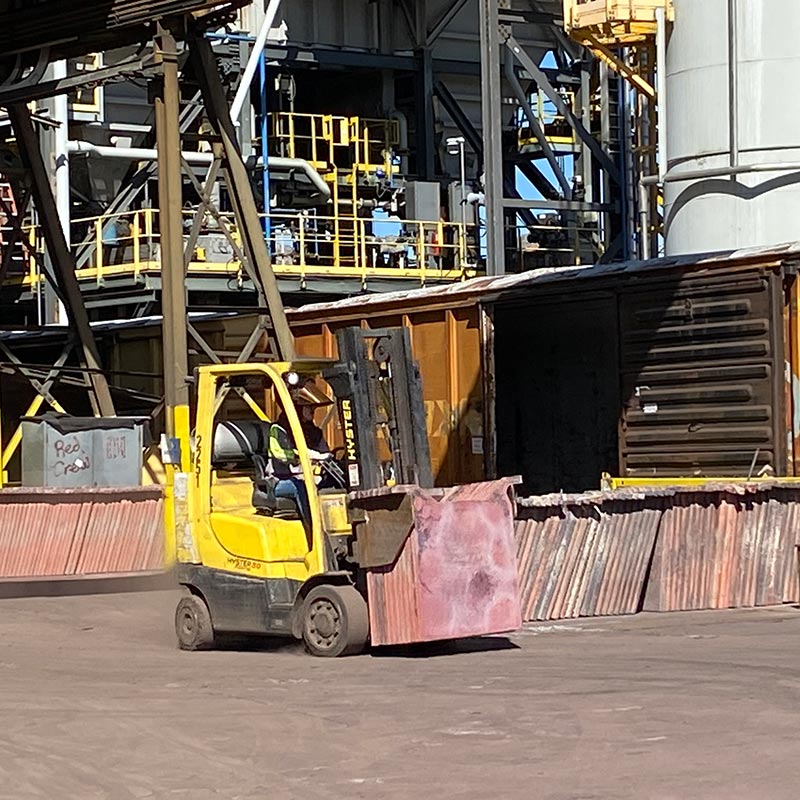
Anode is loaded onto boxcars in Miami for shipment.
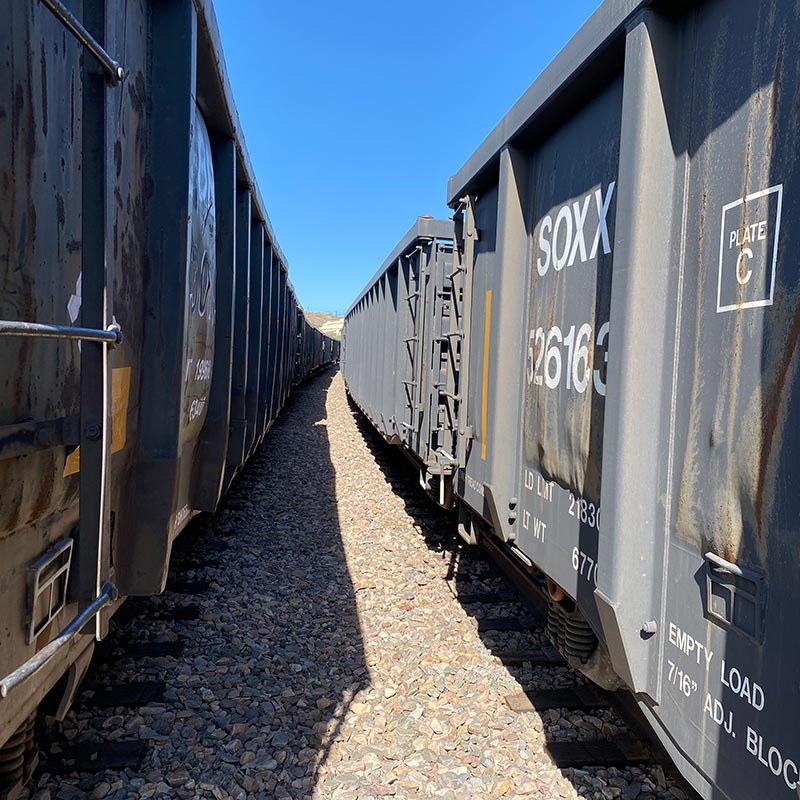
A new storage yard adds space for about 100 rail cars.
‘A game of Tetris’
“It’s kind of like a daily game of Tetris our teams play to ensure the safe movement of all the commodities we need in Miami and the other sites,” said Aaron Friedman, Director-Global Supply Chain Operations. “There is just nowhere to put these rail cars, and because the smelter’s consumption has increased over the past several years, you are seeing all sorts of congestion.”
Most sensitive is the acid. Not only is it needed at the mines for leaching, but Miami also doesn’t have much capacity to store it. If acid cannot be shipped out, available storage capacity quickly will fill, and the smelter would have to be shut down. It’s happened before.
The just-completed train switching yard east of the smelter will provide the ability to move cars around so they can be stored or assembled for shipment without tying up the rail line to the site, said Travis Holder, Senior Supervisor-Smelter Transportation at Miami. The yard includes three parallel tracks, the main line and two sidings with the capacity to store about 100 cars, depending on their size.
Beyond the logistical benefits, the new yard will allow train traffic to go around Miami and Claypool rather than through town as it has in the past.
The next phase is the Acid Rail Loadout Project, which will allow acid to be loaded directly onto rail cars for shipment to the mines. Currently, virtually all acid is carried on trucks.
The ARLO project was delayed until 2026 to better coordinate with potential rail improvements at other sites, especially Safford, Holder said. If a rail spur is added, that would greatly improve the efficiency of shipping acid to Miami’s biggest acid customer. Even without it, ARLO makes sense, Holder said.
“It’s going to pay dividends in the future, as we continue to increase our production,” he said. “These projects are going to be good for the company, good for the community, good for Miami and good for the other properties, as we increase our efficient movements safely within the communities where
we operate.”