
VOL. 07 | ISSUE 1 | March 2024
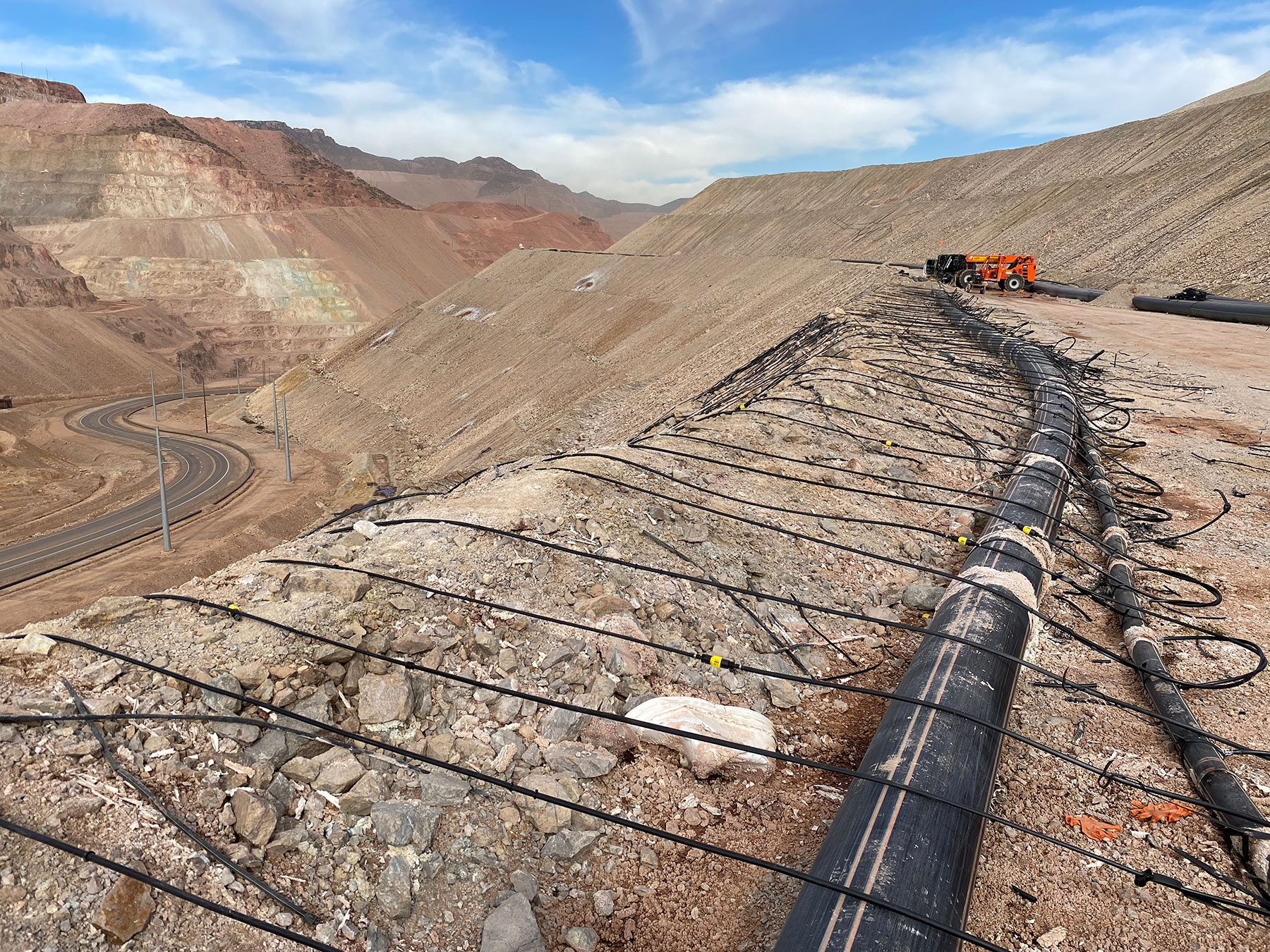
Side slope leaching is paying off in copper at Morenci.
Leach to the Last Drop Delivering Tons of Confidence and Copper
There were a lot of theories and data analytics that made scientific sense behind Leach to the Last Drop when the initiative was launched on a large scale at sites throughout the Americas about two years ago.
Heat would fuel the chemical reactions to unlock the copper.
Data could be used to map the optimal flow of acid.
Side slopes, benches and roads could be irrigated so that whatever copper they held could be recovered.
What was lacking at the time was confidence that it would all work out as anticipated in the real world, and whether it would be economical.
Two years later, the initiative to unlock 40 billion pounds of untapped copper in existing stockpiles achieved the optimistic expectations of the time.
The company hit its first-year goal of reaching a 200-million-pound annual run rate from the innovative leaching techniques in 2023. In fact, Leach to the Last Drop has proven so successful that it is anticipated it will account for 800 million pounds of copper annually within the next three to five years.
“It’s going very, very well,” said Justin Cross, Vice President-Operational Improvement. “We’ve grown our conviction in it. A year ago, it was tough to see how we were going to get to the 200-million-pound run rate. Fast forward a year, and we’ve gotten there. I would say it’s exceeding my own expectations about how far we’d get.”
There are multiple components to Leach to the Last Drop. The most visible at sites in the past year has been covering stockpiles with plastic on the theory that increasing the heat by creating a sort of greenhouse would increase production.
Other components had to do with getting more areas under leach and ensuring acidic solution saturates all areas of the stockpile. That includes targeting side slopes, roads, benches and even old stockpiles written off as not worth working in the past. Beyond leaching everywhere, injection of raffinate solution strategically into deep pockets of the stockpiles is helping unlock copper that previously had been missed by traditional leaching.
Data increasingly drives decisions on everything from where to leach and acidic concentrations to the optimal lift heights of the stockpiles. Sensors engineered at Morenci are being embedded into stockpiles to measure things like heat and oxygenation, which gives leach planners a better understanding of how to maximize production.
“These analytics are helping us gain confidence in areas that we kind of knew, but now we are really getting a much more granular understanding of what’s happening,” Cross said. “When you gain that confidence, you’re willing to spend that extra dollar knowing that you’re going to get $2 in return. Leaching has historically been a bit of a black box, and the analytics are providing clarity as to what is going on in that black box.”
Delivering copper across the board
All the initiatives have worked out at least as well as anticipated, Cross said. As have the costs of the various techniques at about $1 per pound of copper produced on average.
If there was a surprise, it was the success of the leach everywhere component, Cross said. Getting solution onto more ground, including the side slopes of stockpiles, has produced about half the additional pounds that have come from Leach to the Last Drop. Another 30 percent or so came from deep-raff injection – injecting raffinate solution deep into untapped areas of the stockpile – and the rest was primarily from the benefits of applying additional heat through covers.
Site wise, about half of the additional pounds coming from Leach to the Last Drop are from Morenci. The primary focus of the initiative is Morenci, Chino, Safford and El Abra, though all sites are involved in optimizing their leaching methods.
Long-term estimates show about 40 billion pounds of available copper at active company mining sites that can be tapped through innovative leaching techniques. Given the low cost, some thought has been given to the potential of leaching stockpiles at closed mining sites the company owns, but that has not been a focus and those sites are not factored into the 40-billion-pound estimate.
“It gets you thinking differently about what’s truly waste,” Cross said. “It converts what used to be waste into potentially economically viable material.”
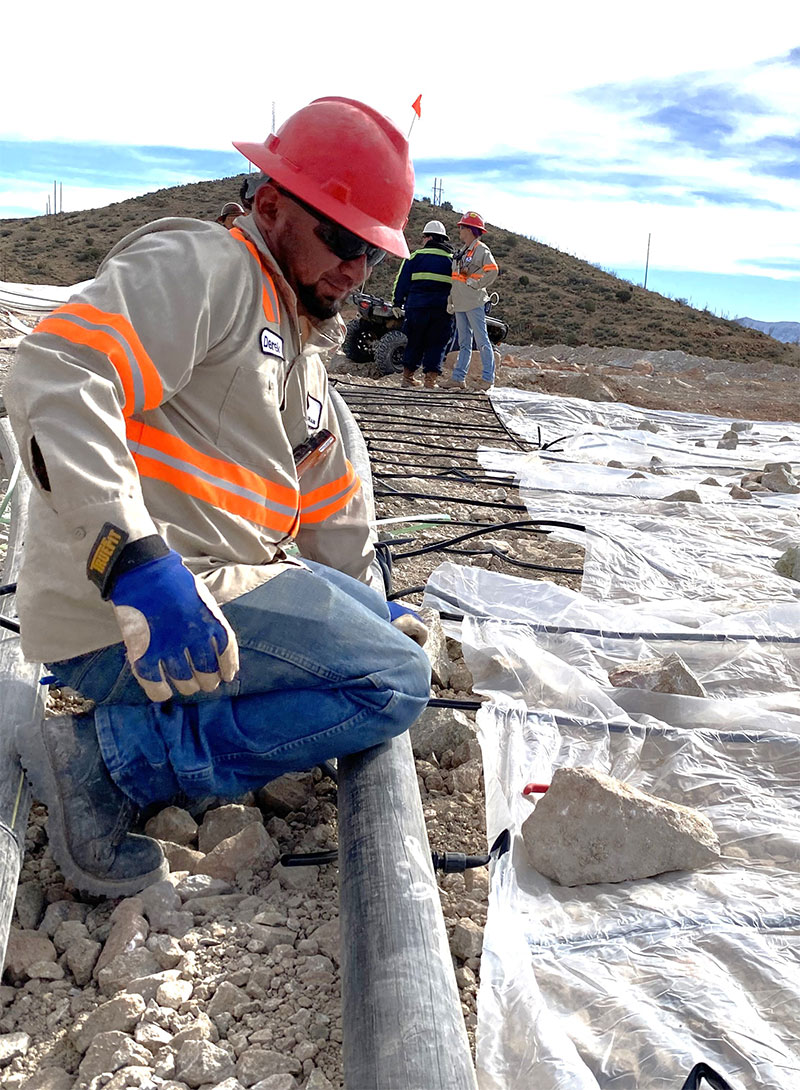
Derek Dominguez, Hydromet Leach Operator Trainee, attaches leach lines at a covered stockpile at Morenci.
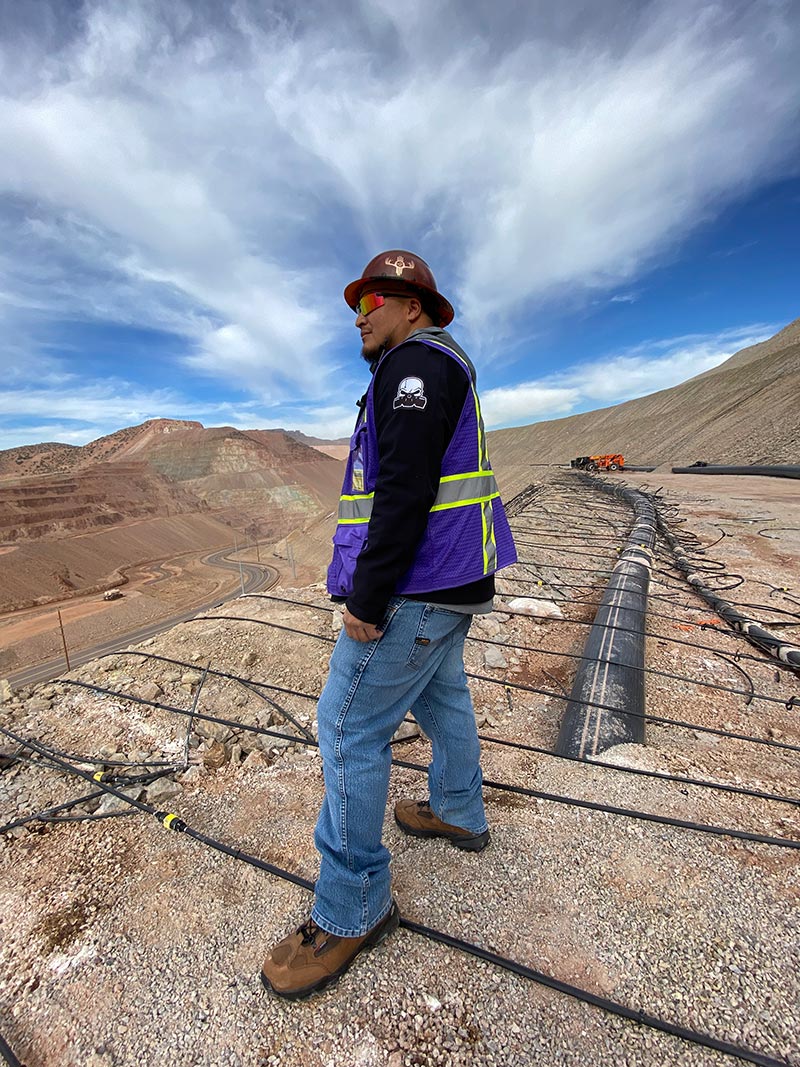
Hector Romo, Hydromet Leach Operator II, looks over the leach lines that are being laid on side slopes at Morenci.
Success in Morenci Leaching Leads to Optimism and Commitments
The Upper Chase Creek Extension stockpile in Morenci had long been viewed as a low-value asset and not a high priority. The ore grade was so low that there were no immediate plans to squeeze out the little bit of copper thought to be there.
But Leach to the Last Drop changed things. With “leach everywhere” part of the new thinking, the stockpile was put under leach and now is producing about 1.5 million pounds of copper per month.
That kind of success is producing more than copper. It’s generating optimism and confidence in the innovative leaching techniques that will unlock billions of pounds of copper from the company’s existing stockpiles, said Paul Cook, Manager-Leaching at Morenci.
Many of the techniques that go into Leach to the Last Drop were implemented in Morenci in 2022 or earlier, before they were given a title and pushed companywide. Success during those early stages gave Cook the confidence to commit to a 100-million-pound annual forecast, which the site hit in 2023.
“We’ve gained enough confidence in this that we’re making commitments in our forecast, commitments that we’re going to produce pounds that we haven’t absolutely proven out yet,” Cook said.
About half of the copper produced at Morenci from the new leaching techniques is from leaching everywhere. This is consistent with the proportions from all company sites. No initiative has failed to work as anticipated, and things like leach everywhere and deep-raff injection have delivered results that surpassed expectations, said Pranav Attavar, Superintendent-Leaching/Continuous Improvement at Morenci.
“That really motivated a lot of our front-line employees when they saw the results,” Attavar said. “That got them even more energized. It really gave the group a lot more ideas of how we can maximize this.”
Overcoming challenges with coordination, cooperation
Some things did not go quite as planned. Installing data sensors into the stockpiles took longer and was more difficult than anticipated, but the initial problems have been resolved, Cook said.
Another challenge was coordination with other departments, especially on things like deep-raff injection, Attavar said. Before the raffinate can be pumped deep into the stockpile, mine planners must be consulted to ensure drilling does not interfere with other mine operations. Plant engineering must verify sufficient pumping capacity. Leach operations must provide adequate staff, and the technical group must be able to monitor what’s happening. All this work must be done without compromising worker safety or the integrity of the stockpile. That’s just the coordination before any holes are drilled.
“The most important is the safety piece,” Attavar said. “This is uncharted territory. We have not really gone out there and drilled our stockpile before. This is the first time we’re doing it for this purpose, so there’s an element of the unknown. All of this put together is what makes it challenging.”
The success of the past year has given Cook enough confidence to commit to producing 146 million pounds at Morenci this year. Delivering those additional pounds will come in part because of the enthusiasm that success has brought.
“It helps people have that mindset which is super important in working on projects like these where you don’t have a standard scope of what to follow,” Attavar said. “You are literally writing the book as you read it.”
Morenci leach cover installation crews determined it was easier to use the site’s abundant rocks rather than sandbags to hold down covers.