
VOL. 07 | ISSUE 1 | March 2024
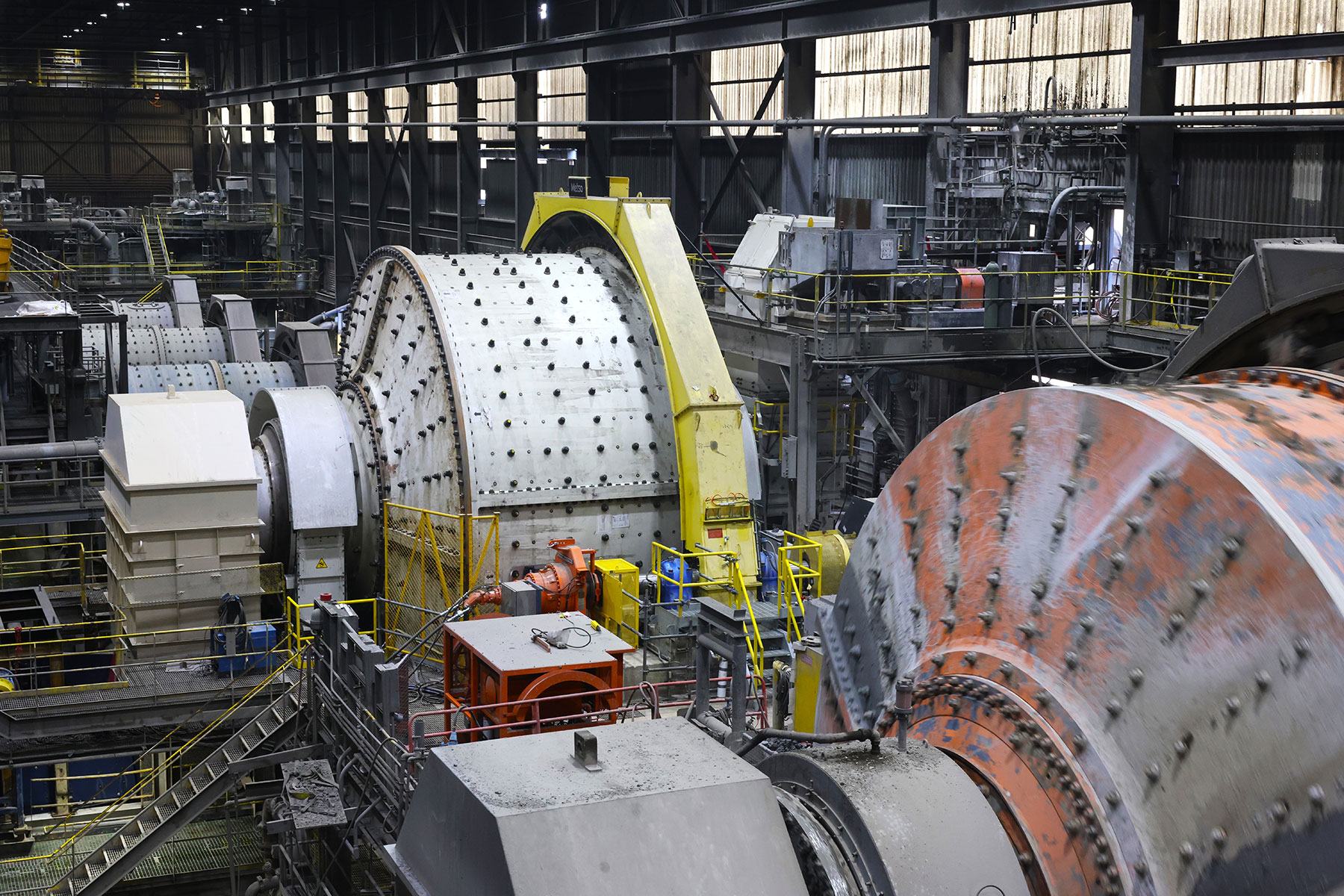
SAG 2 (center) is the first of several mill replacements planned for Chino.
New SAG Mill Elevates Chino’s Capabilities
An alarm blares. Employees retreat. And the floor begins to vibrate with the rising crescendo of colliding rock and steel. For the uninitiated, this might seem like cause for concern. For the maintenance team at the Chino mine concentrator, this is the moment toward which they all have been working. Now, in December, after years of planning and months of work, the first of two new SAG mills finally has begun to roll – and the team’s attention turns to the second.
Although portions of the planned work would not begin until the following year, 2022 was declared the “rebuild” year for Chino. It was the second phase of a five-year, post-pandemic strategy meant to revitalize the mine and, General Manager Randy Ellison hoped, set them on a path toward becoming a copper mine with lower costs, higher production and the ability to better weather economic uncertainty.
“We’re trying to elevate what Chino is capable of,” explained Ellison. “To do that, we need the right people with the right skills, right information and right equipment.”
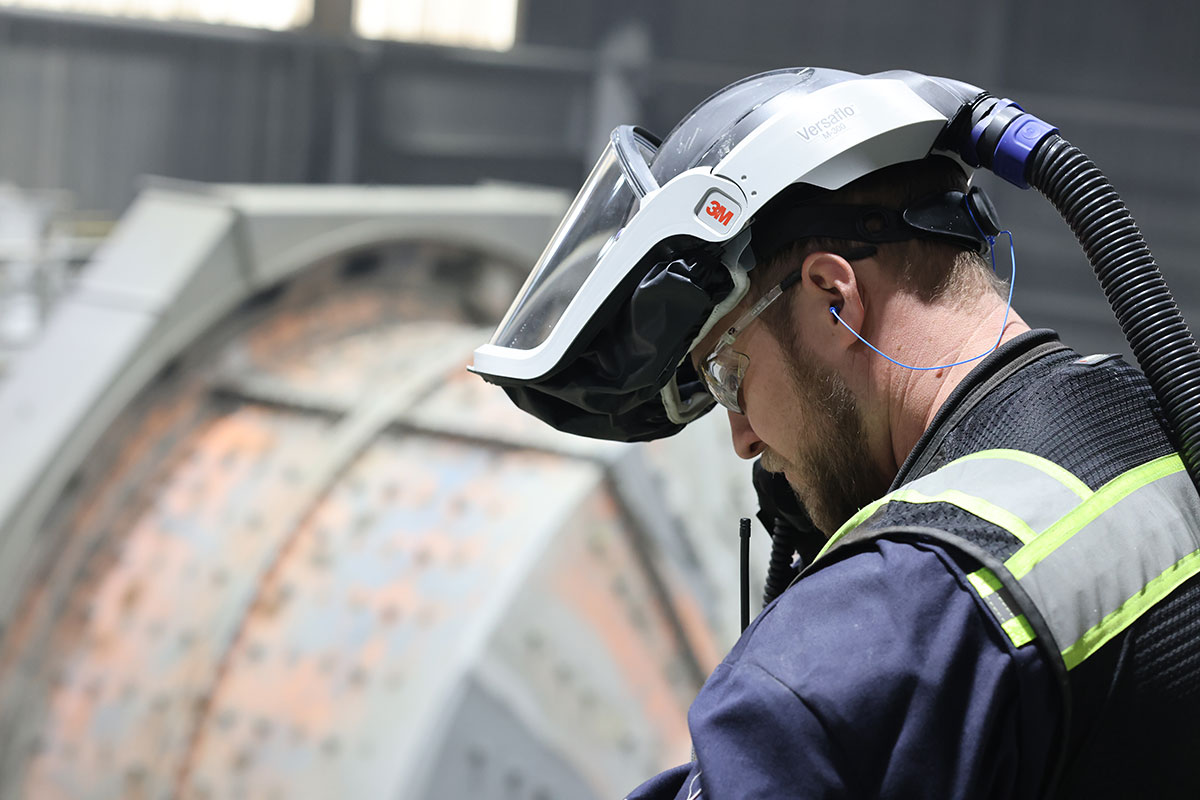
Jarret Yargus, Senior Metallurgist-Chino, monitors for issues during initial startup.
Rebuilding is the most visible portion of that equation, and Chino’s concentrator already has been one of the biggest beneficiaries. However, a key component in ensuring the 2022 rebuild effort pays off is the replacement of the site’s two, 40-year-old semi-autogenous grinding, or SAG, mills. “It’s hard to overstate the importance of this changeout,” said Rhett Hanson, Senior Supervisor-Mill Maintenance at Chino. “We could only follow the path we were on for so long before we’d hit a dead end, so we’re all really excited about this new direction.”
Hanson, who has worked maintenance at the mill for the last 20 years, explained the site had trouble keeping liners inside the SAG and struggled with everything from washed out bolt holes to poor seals. At one point, the Corporate Operational Improvement team came in to oversee extensive repairs. This ultimately helped those working on the project make it to the planned changeout, which, even with the involvement of countless contractors, still necessitated months of downtime for that unit.
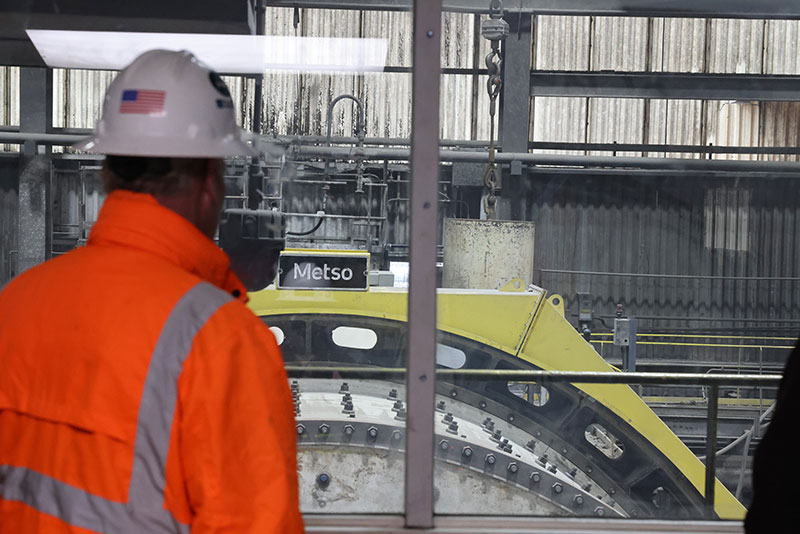
An engineer watches as the new SAG is loaded with charge.
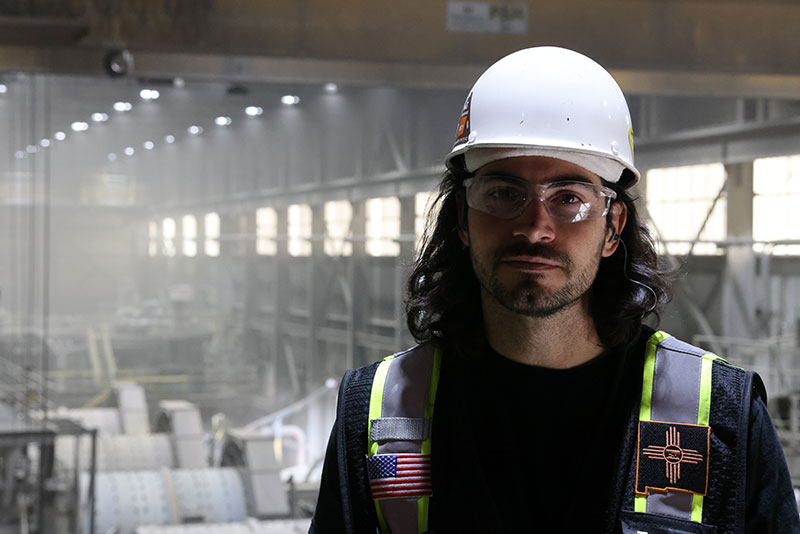
Fernando Sanchez, Mechanical Engineer II-Chino, spearheaded the replacement of the SAG mills.
“It’s not just the shells,” said Don Jensen, Concentrator Manager-Chino. “It’s all of the gears, all the motors, all the lube systems – everything that will let us achieve a high asset efficiency for many years to come.”
The project was spearheaded by Fernando Sanchez, Mechanical Engineer II-Chino, who explained that, when it came to this project, even the routine was not routine. The project faced a variety of unique engineering challenges, such as concrete demolition. Since the new SAG had different bearing dimensions, over 100 cubic yards of old concrete had to be removed. For this, the team brought in a contractor to do hydro-demolition, as jackhammers had the potential to damage the foundation and disrupt continuing operations elsewhere in the mill.
However, the all-encompassing nature of this project also provided an opportunity to leverage decades of experience and allow critical input into the planning.
“It’s about taking into account past issues,” explained Sanchez, “for example, ease of maintenance in the lube skids as well as ease of operation of the whole system incorporating more of an automated design.” To that end, the new SAG features larger liner bolts, self-lubricating bearings and load sensors, and it also takes advantage of a centrally located motor control center and new lube room – all with a goal of extending service life and reducing downtime.
Chino also had the opportunity to learn from this replacement, which was rife with challenges that put the project behind schedule and impacted operations. This ultimately led to the decision to push out the start date of its next project.
By taking a step back, Sanchez said, the team is reassessing the work before moving forward, potentially reducing the amount of actual downtime for the second SAG. The team instead will address pre-work in the interim, incorporating recently learned action items into the planning and implementing new procedures to clear as many roadblocks as possible before taking the old equipment offline.
Operators Get Assist from Modern Equipment
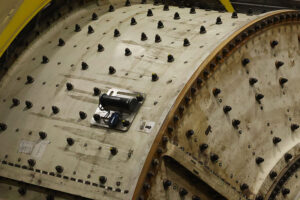
A sensor on the new SAG measures charge toe angle during operation.
Chino’s new SAG is equipped with a variety of sensors that listen, watch and even feel to ensure everything is dialed in correctly. According to Mike Foley, Superintendent-Process Automation at New Mexico operations, a microphone measuring noise levels and a mill scanner measuring the toe angle can help determine when the mix inside the SAG is out of balance, so the feed automatically adjusts to compensate.
While those two might be standard, a load sensor – a first for Chino – is being added with the aim of preventing overloading and ensuring more efficient operation, even if it never entirely replaces the need for human oversight.
“Computer algorithms and sensors, the advanced process control, make it possible to automatically respond to changes in variables of the milling operation quickly and consistently,” Foley said. “However, it will never replace an operator’s ability to deal with the unexpected situations which typically arise suddenly, without warning.”
That second SAG replacement still is slated to be completed in 2024. Though the “rebuild” year has come and gone, the continuing work plays into other goals in Ellison’s five-year strategy, including changing the culture at Chino.
In Jensen’s eyes, this new SAG should help contribute to that, and he expects to see a lot of pride with the new equipment. The new SAG is going to help a new generation of miners process ore without being burdened by the same reliability issues, he explained.
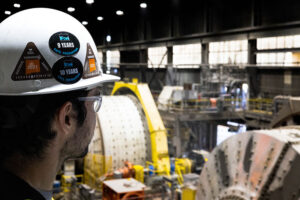
Sanchez watches as workers conduct final checks on the new SAG.
“Over the years, a lot of changes have come out of the way we operate it and the way we maintain it,” Hanson said. “And from where we go on with this new SAG, continuing with what we’ve learned, we should sustain this for many years to come, so maybe your kids or my kids in the future can work here for many more years.”