VOL. 09 | ISSUE 1 | Spring 2026
Skills-Based
Training Takes
Off with New
Pilot Programs
This is the third story in a series exploring Freeport’s shift toward becoming a skills-based organization – part of its commitment to employee growth through closing skills gaps, enhancing performance and delivering consistent, accountable training.
Freeport’s new skills-based approach to training is taking a big step forward, as pilot projects roll out in Hydromet and Health and Safety. The goal is simple: Make sure every employee has the right skills to work safely, grow their careers and achieve business goals.
This phase follows months of foundational work to identify exactly what each job requires. From there, subject matter experts and employees closest to the work developed clear standards and created baseline and in-field assessments to verify those skills in everyday operations.
About 200 Hydromet employees across Morenci, Safford, Chino and Tyrone, along with some 100 Health and Safety specialists across North America, are part of the pilot.
Getting started
Supervisors began baseline assessments in January designed to better understand employee strengths and opportunities for development and support, such as additional training or on-the-job mentoring. Next, they meet one-on-one with employees to talk through the results and outline next steps for development.
Field assessments, led by experienced practitioners, come later and give employees the chance to show their skills on the job. The idea is to verify every employee is well prepared to perform their current job safely and with confidence, which in turn creates clear pathways for career growth.
“We’re looking at how we can help employees become the best they can be at their current level,” said Mike Brewer, Manager–Career Development. “These skills and competencies reflect what’s expected for each role. To advance, employees must show proficiency at their current level and demonstrate readiness for skills at the next level.”
Why this matters
In the past, requirements for the same job could vary by site, which sometimes made promotions, transfers or temporary assignments more challenging. The skills based approach sets one clear standard across locations and evolves Freeport’s Lines of Progression into skills-based LOPs, shifting focus to developing and demonstrating the skills needed for progression.
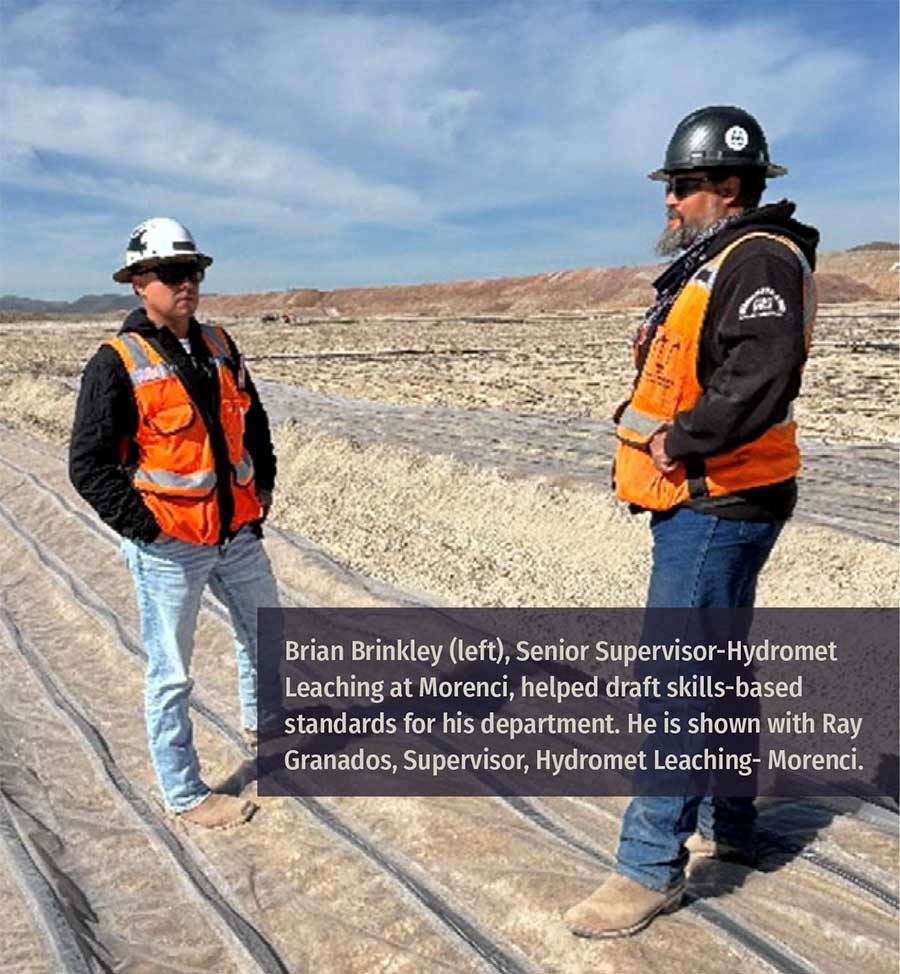
“The main thing is knowing the job and doing it hands on,” said Brian Brinkley, Senior Supervisor, Hydromet Leaching-Morenci, who started as a leach operator trainee in 2007 and helped draft standards for his department. “This is stuff that we really need to know to do this job safely.”
Hydromet and Health and Safety were selected for the pilot because both groups already were far along in defining standards. This progress was supported by earlier skills development work led by Jackie Steeples, Processing Manager-Operational Improvement, and Anna Laija, Director-Safety and Health and Learning and Development. The pilot includes operator I and II roles in Hydromet, and specialists, supervisors, senior supervisors, leads and senior leads in Health and Safety.
By the end of the year, this skills-based training is expected to expand to most operational and maintenance departments in North America.
“To advance, employees must show proficiency at their current level and demonstrate readiness for skills at the next level.”
MIKE BREWER | MANAGER–CAREER DEVELOPMENT
Tools that support the work
To support all this work, new technology tools are coming online. Employee results will be incorporated into future
career planning made easier through the employee’s Growth Portfolio, which tracks skills, proficiency level and learning opportunities for development. A new Talent and Training website provides access to skills-based information, FAQs and tools to help employees develop skills and more.