VOL. 07 | ISSUE 4 | December 2024
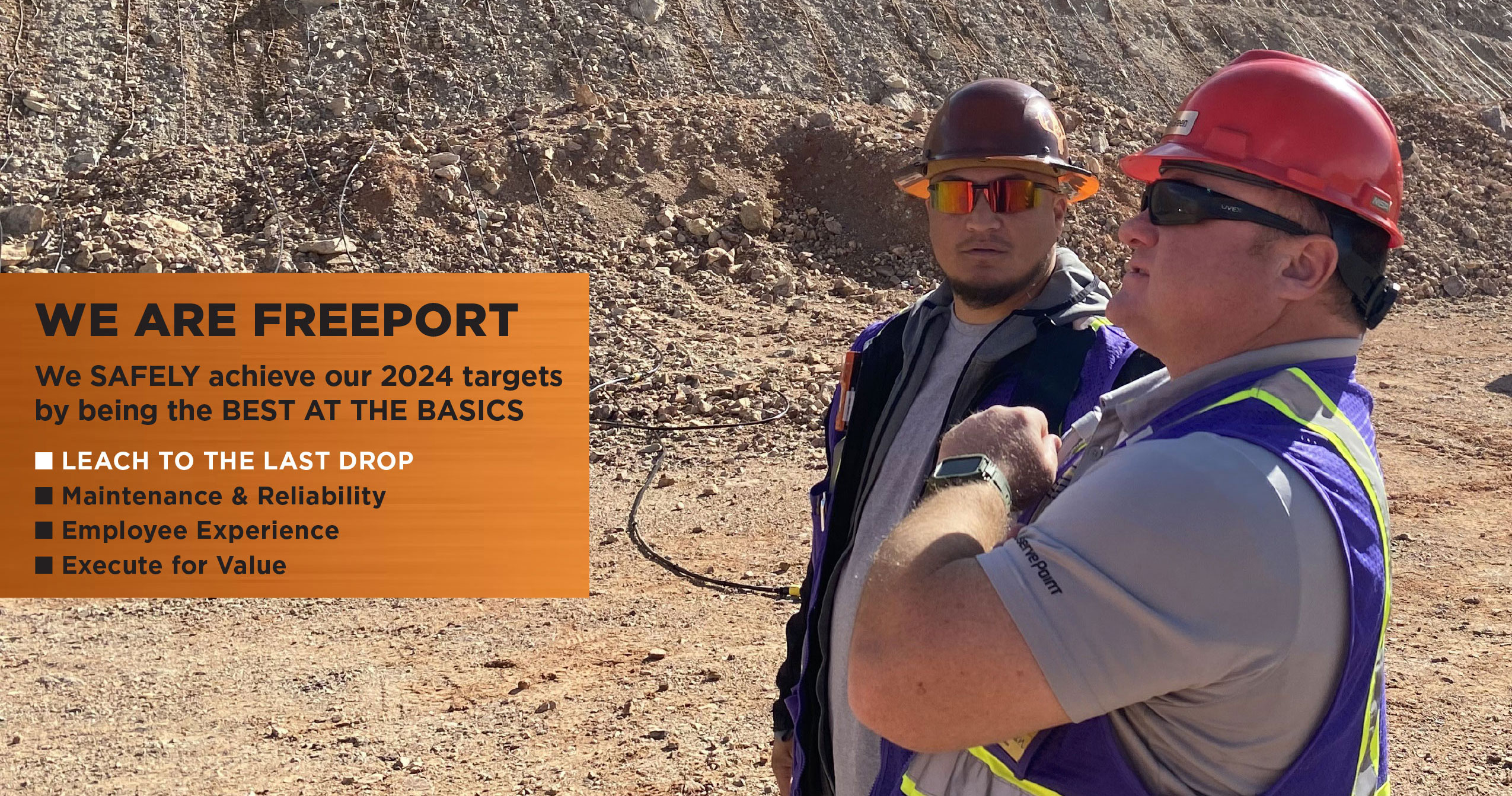
Project manager Jason Green (right) and Hector Romo watch drip lines being laid by hand on the side slopes of stockpiles.
Helicopters Take Morenci Leaching to New Heights
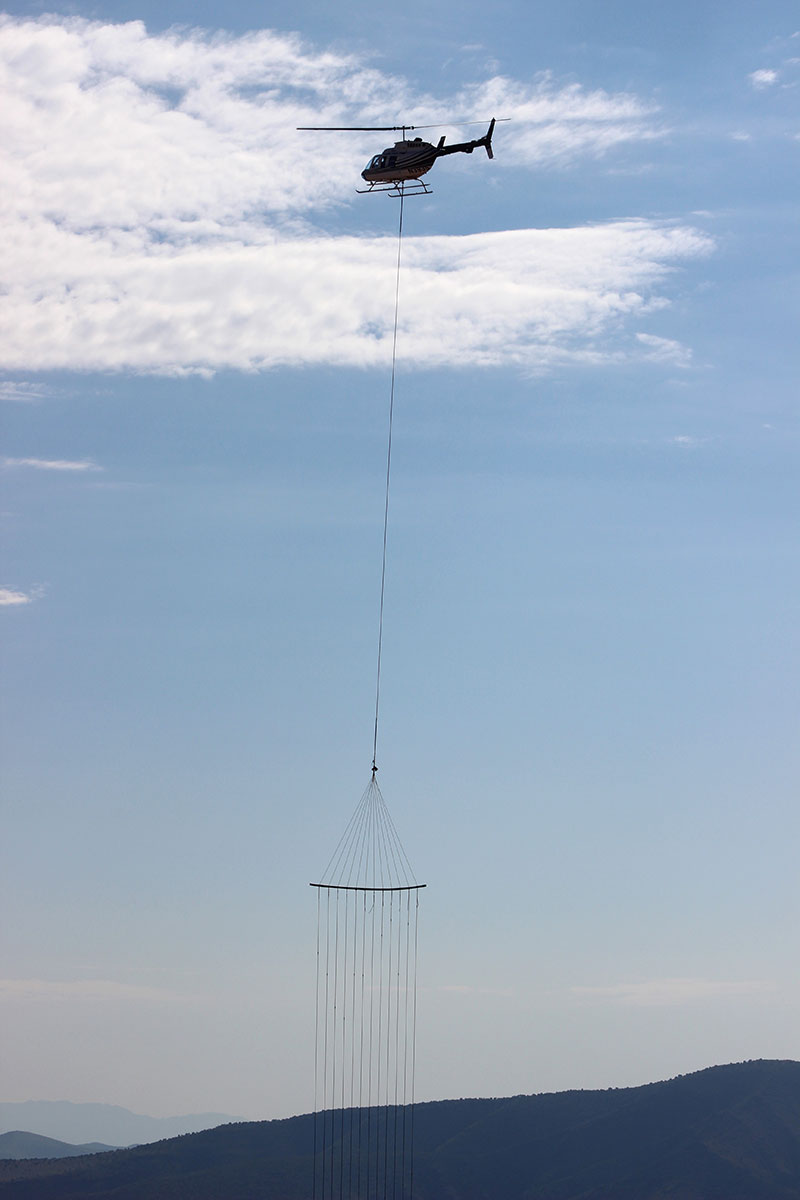
They’ve gone airborne in Morenci to squeeze more copper out of the long side slopes on existing stockpiles that had been out of reach – even with the company’s innovative Leach to the Last Drop initiative.
Morenci’s leaching continuous improvement team has started using helicopters to lay down mats of drip lines on long side slopes without benches. In the past, these areas were not accessible to the traditional method of stringing drip lines by hand with workers using ropes to rappel down. The lack of benches on those slopes meant the runs were too long to stage equipment and people safely.
But rather than writing off those slopes – and the copper embedded in them – the leaching team thought up ways to fly the lines into place. At first it seemed unmanned drones might be the answer. But given the weight limits and regulatory red tape of using drones to carry heavy loads, testing soon turned to helicopters. They proved so successful that what began as testing quickly transitioned to implementation, said Hector Romo, Lead Engineering Technician-Morenci. That has put Morenci on track to put millions of square feet of side slopes under leach.
Finding solutions
“We kind of surprised ourselves with how it came to be in its entirety,” said Romo, part of the leaching innovation team in Morenci, Arizona. “We literally went from trials of deploying four harnesses to deploying eight harnesses.”
“We had too much inaccessible area where crews could not get in because there was no bench, so it would be unsafe to be on that face,” Romo said of the problem that needed solving. “So, they just called it a no-go area. We had to figure out a way to make that area recoverable again and not a hard no.”
In the first few days of flying, about 800,000 square feet of drip line was installed using helicopters lifting multi-strand mats designed with the support of Steven Richardson, Senior Principal Engineer-Phoenix. In a single day, helicopters installed 24 of the drip mats covering about 460,000 square feet.
As of October, about 1.5 million square feet of leaching mats have been laid using a helicopter.
Leach to the Last Drop is the company’s initiative to use innovative leaching techniques to get acidic solution to areas of existing stockpiles more completely and efficiently, thereby accessing copper once thought unrecoverable. In 2023, the company achieved the target of reaching an annual run rate of 200 million pounds of additional copper from the techniques, including side slope leaching. With estimates of nearly 40 billion pounds of copper locked away in existing stockpiles, there is the potential to grow that exponentially.
Morenci accounts for about half the new copper generated from Leach to the Last Drop.
Historically, leaching solution was put at the top of stockpiles and recovered at the bottom in a copper-rich solution. But with the pyramid-type shape of stockpiles needed for stability, much of the mined material on the side slopes was not accessible.
Side slope leaching involves stringing leach lines to those side slopes.
Helicopters easier to deploy
Drones seemed promising at first, and testing began in May. But they proved problematic. Getting federal approval to use drones for hauling heavy loads takes a lot of paperwork and regulatory approval, so that slowed things down. The drones also are expensive to buy and operate and have weight restrictions – less than 100 pounds – which limits their effectiveness on a large scale, said Shane Tuerr, Engineering Specialist II-Morenci.
Helicopters can safely lift an 800-pound payload, and Morenci already contracts with an outside company to use them to lift heavy equipment when necessary, Romo said.
Drones still have potential to be used where helicopters cannot be safely operated, such as around power poles and other obstructed areas, Romo said.
This is some of the cheapest copper we can produce. These are the slopes that with the traditional methods of leaching our ground crews cannot reach because there’s no access above and below. These are slopes that otherwise would not be leached at all, so it’s basically an incremental add of copper to the production plan.
The mesh mats are built on site using multiple drip lines – typically six – separated by polymer HDPE pipes and attached to a rope harness, said Jason Green, Project Engineer II and project manager on the helicopter initiative. The mats can be as long as 800 feet.
The helicopter is used to lift the mats from the bottom of the slope and string them to the top where the harness is removed for reuse and the individual lines can be connected to larger piles.
A mat can be built in about an hour. Currently, Morenci is using one helicopter operated by a contractor.
“This is some of the cheapest copper we can produce,” Green said. “These are the slopes that with the traditional methods of leaching our ground crews cannot reach because there’s no access above and below. These are slopes that otherwise would not be leached at all, so it’s basically an incremental add of copper to the production plan.”